


The victors in the lengthy fight over the Matata sewerage scheme are calling for the resignation of the councillor accused of starting the struggle, which they say has cost ratepayers $2.5 million.
Sustainable Matata chairman Ed Campion and secretary Neville Harris say the council only decided to proceed with the sewerage scheme after Rangitaiki ward councillor Russell Orr changed fellow councillor's minds.
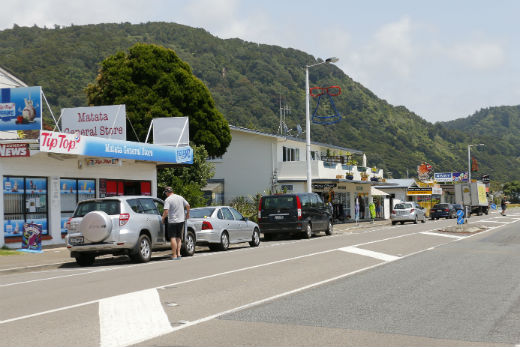
Matata's main street. Photo: File.
The full council decided to drop the scheme at a meeting on August 1, 2012. Ed and Neville say they have a copy of the email Russell sent to council members and staff on Jan 28, 2013, urging them to go ahead with the scheme.
They add that the council decision was changed as a result of that email, a ruling which has cost ratepayers $2.5m in fees to lawyers and consultants on the sewerage scheme proposal.
'We are of the opinion that the councillors who were pushed into this should repay the ratepayers the $2.5m, and the instigator of the project, councillor Orr, should resign over his initiation of the waste of $2.5m ratepayers money,” say the pair.
In a written reply, Russell says Sustainable Matata's claims are incorrect. The Whakatane District Council decided in 2012 to proceed with a limited scheme that only provided a reticulated wastewater system to a limited number of residents in Matata who had ground soakage issues.
'I did not consider that was fair on the rest of the residents and neither did the Ministry of Health, who agreed to continue to make their generous subsidy available to the whole community. The BOP Regional Council also thought it was a good idea to include the whole town and agreed to contribute another $1.8m. I asked council to reconsider on the basis that the subsidies were still available and the scheme was going to be of benefit to the people of Matata and the district as a whole.
'Council not only agreed unanimously to support the full reticulation, but also agreed to spread the remaining capital and operating costs across the district. This meant that the project was 100 per cent subsidised and I believe that council saw it as a ‘helping hand' for the folk at Matata who had been through some tough times.
'The writer has continued to maintain his opposition, but his claim that the scheme was not wanted or needed, and the costs were unaffordable, was not accepted by either the independent Hearing Commissioners or the Environment Court. It is unfortunate that the Environment Court considered that the proposed location was unsuitable in the end, but no decision on the future of the project has yet been made.
'I do not propose to resign and will continue to work towards getting Matata back on its feet and finding a way forward for the vast majority of people who supported this project. I do, however, wonder if the writer will be prepared to compensate the Matata residents who may be left facing very expensive septic tank upgrades as a result of his selfish opposition to this worthwhile project, but realise this is very unlikely to happen.”
In his decision, Environment Court judge Jeff Smith found the evidence did not provide a clear picture of the adequacy that 265 septic tank systems would have in Matata, nor the extent or the seriousness of the problems that have been experienced with them.
'While we respect the expert opinion on public health issues, we were faced with conflicting views and very little factual information relating to Matata to assist us in quantifying the risks and benefits,” says the judge.
'When we sought to understand the environmental benefits, we found the evidence to be largely silent. Responses to our questions did not assist us greatly either, leaving us with some difficulty in understanding the overall benefits of the scheme and how they compare to the proposed additional contaminant loads at the land application field,” referring to the dune land where the treated effluent will be piped into the ground.

2 comments
Where was Plan B Orr C
Posted on 15-06-2015 14:25 | By Road Ranger
Congratulations to the Environmental Court on reaching this decision. Again the WDC did not have an alternative scheme in mind. Not only was their a risk of contamination in the dunes but also in the surrounding farmland - even now farms are affected by salt water. Why didn't they look at a less productive site for the treatment plant. More communication/public meetings by the WDC may have helped everyone understand the situation.
HA,HA,HA!
Posted on 15-06-2015 15:15 | By How about this view!
Good luck with removing a snout from the trough. We have elected people all over the upper north island that are put there by people believing that things will change, only to find that there is nothing between the ears and that they are only too willing to take advice and information from seat warmers with nothing to lose. Sack ALL the Councillors and get the seat warmers to explain their personal ideology in decision making and become answerable to the public that pay their wages. How many political viewpoints do ratepayers fund?
Leave a Comment
You must be logged in to make a comment.