


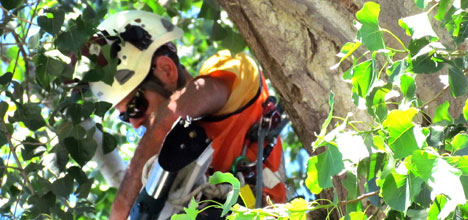
Tauranga's historic ‘Aspen' again has an arborist clambering about its upper limbs.
Paul Kenny is a ‘well respected highly qualified arborist' brought in as consultant to give a report on the historic black cottonwood tree's future prospects.
Paul Kenny examines Tauranga's 'Aspen' tree.
'He's looking at stuff we didn't have the opportunity to look at when we carried out the emergency work,” says Tauranga City Council arborist Richard Conning.
'In terms of the roots and a bit more testing on that higher level of trunk, to see what the levels of decay are like up there.”
An eight tonne limb fell from the tree onto McLean Street on January 17, narrowly missing parked cars.
Rot can clearly be seen in the hole in the trunk left by the missing branch.
An inspection found cause to drastically reduce the historic tree. Branches overshadowing neighbouring properties were lopped and the tree was reduced in height by about 16m. Contractors took about 20 tonnes of wood off the tree.
Paul's inspection of the tree is taking place today and tomorrow, says Richard.
'Once he's done that he will provde us with a clearer picture of where we are at.
'At the moment what we have done with the tree has made it as safe as we can within the rules of the district plan.
'We still have to have in mind that it is a protected tree and there is only so far you can go before you need a consent.
'We have got to get a clear picture in our head of what the tree is like on the inside and then we can make some decisions and make some recomendations to the elected members.”
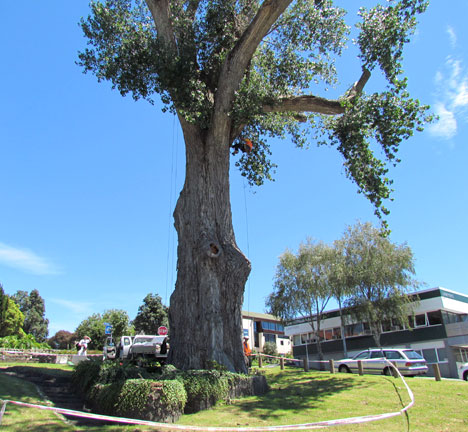
City council contractors Arbour Care pollarded the tree, a centuries-old pruning practice originally used to grow and harvest firewood without killing the tree.
If it is in good health, the cottonwood could live another 150 years. Pollarded trees tend to live longer because they are maintained in a partially juvenile state, and they do not have the weight and windage of the top part of the tree.
But once pollarding is begun the practice has to be maintained. As new branching shoots grow and expand they push against each other. The tree eventually develops weak crotch angles that allow moisture into the wood, causing rot.
'Photos from the 40s and 50s show some large lower branches and they were removed round that time,” says Richard.
'The removal of those branches has probably contributed to the decay in that lower trunk of the tree.
'Poplars when they get to that size will develop decay anyway, so there's a combination there of old past practices and the nature of the tree.”

3 comments
Aspen Tree
Posted on 27-01-2011 18:29 | By Glen Clova
Waste of money cut it down and sell it for firewood,one way for the council to save a fee bob.
Aspen ? not even a native!
Posted on 29-01-2011 15:54 | By THE RING MASTER
Rotten to the core
Now that just aint pretty now
Posted on 30-01-2011 17:35 | By THE RING MASTER
Not even before, best answer is 'put another log on the fire'
Leave a Comment
You must be logged in to make a comment.