


.jpg)
Robots pollinating flowers and picking kiwifruit, drones monitoring orchards from above and management decisions made on 'virtual orchard” models are coming to the industry soon.
That's according Steve Saunders – owner and managing director of Gro-Plus of Te Puna.
Primary Industries detector dog Ayla and her handler Sarah Carley. Photos: Elaine Fisher.
'We have 14 of New Zealand's top PhD scientists working on the robot and I'm confident we can do it,” says Steve.
The project, underway at Newnham Park, Te Puna, has funding from the Ministry for Business Innovation and Employment and support from Waikato and Auckland Universities.
Steve says the industry is facing a shortage of skilled labour, and with the introduction of the new gold variety, has undergone a paradigm shift which is opening up the potential for the use of more autonomous platforms.
Steve was among the keynote speakers at Zespri's inaugural Kiwifruit Innovation Symposium held in Mount Maunganui yesterday, where he told 200 delegates about the advances in orchard management Gro-Plus is involved in.
These include using drones to fly over orchards to monitor aspects such as pruning, production and canopy health; methods to sample soils in individual parts of the orchard to apply site-specific fertiliser and the creation of 'virtual orchard” models to plan and monitor management.
The symposium not only looked at innovation within the industry, it was innovative in itself.
Instead of the usual format, with the audience sitting in front of a stage, delegates sat on bean bags, couches and bar stools at tables surrounding a central stage from which presenters gave their addresses.
Large television screens around the room ensured everyone had a clear view of proceedings.
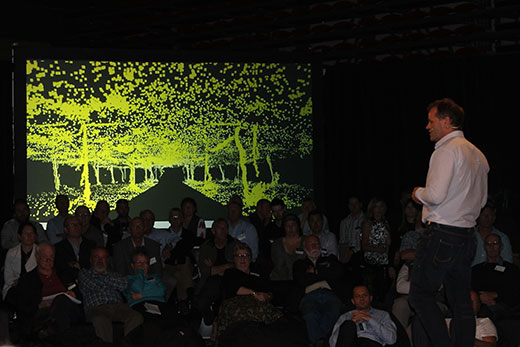
Virtual orchards will be management tools of the future Steve Saunders of Gro-Plus told Zespri's inaugural Kiwifruit Innovation Symposium.
Their topics included new cultivar developments, on-orchard productivity, fruit taste and quality, health and nutrition and bio-security.
And it wasn't all technical. Within seconds of entering the conference room, three-year-old Ayla found an apple in the bag of one delegate, demonstrating how acute the sense of smell of detector dogs is.
Her Ministry for Primary Industries detector dog handler Sarah Carley, alongsideZespri's Dr Elaine Gould, explained the work of the dog teams and their importance to the industry.
However, biosecurity is the responsibility of everyone in the industry, Elaine says, and growers must remain vigilant for anything unusual which they see on their orchards.
The incursion of the bacterial disease Psa in 2010 highlighted gaps in the industry's knowledge, and while a lot of those gaps have been filled, there may be others which present potential threats.
To meet those challenges, Zespri and Kiwifruit Vine Health is part of a biosecurity strategy group made up of Scion, Ministry for Primary Industries, Plant and Food, NZ Avocado and Better Border Biosecurity (B3) – a multi-partner, cooperative science collaboration that researches ways to reduce the entry and establishment of new plant pests and diseases in New Zealand.

0 comments
Leave a Comment
You must be logged in to make a comment.