


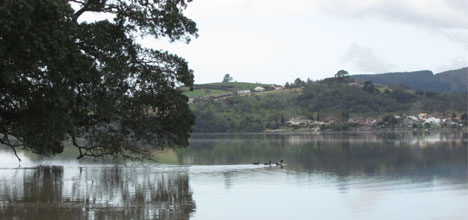
Welcome Bay residents are challenging Tauranga City Council plans for walkways in the area saying what is planned are a continuation of decades of environmental mismanagement.
The Welcome Bay Waterfront Association has presented a petition and report to the council's strategy and policy committee slamming its environmental management.
Welcome Bay.
The council's model as contained in its Harbour Reserves Management Plan, is failing the estuary and failing it conspicuously, says the report's deliverer Robin Rimmer.
'The decline in the state and health of the Welcome Bay estuary over the last 40 years caused by council's harmful actions, negligence and neglect has led to the inevitable conclusion that council and its planners do not value Tauranga's estuaries,” says Robin. 'This has become even more evident by the fact that, having for 40 years spent little or no money on repairing, protecting or preserving the Welcome Bay environment, council now proposes to spend more than $2 million on building a network of walkways / cycleways / boardwalks around almost the entire perimeter of this struggling estuary.”
The Welcome Bay boardwalks have been shelved for financial reasons. They have been pulled from the current Ten Year Plan and are next up for review in 2017.
'The council informs us it is a funding issue, but for the residents it is still very much an environmental and social issue,” says Robin.
The planning issues raised within the report are the subject of an appeal to the Environment Court filed by Robin on behalf of the Welcome Bay Waterfront Association. One other appeal has been filed in respect of the council's decision on similar matters and other parties have registered their interest in the appeals.
All parties attended Environment Court mediation on August 30. The decision on any terms of settlement for these appeals lies with the full council.
Robin says he's asking the council to reject its current model of neglect followed by large scale development, and replace it with a conservation model.
The boardwalks proposal is rejected for environmental, social and political reasons.
The residents say walkways will add to the estuary's pollution and rubbish woes and precipitate a further decline in the endangered native bird population.
'It is difficult for those who have been, and continue to be, the estuary's principal guardians to understand how a group of planners and councillors could decide, without a comprehensive assessment of the environmental impact, without proper consultation, and in face of widespread opposition, that the quiet and beautiful, but fragile and struggling Welcome Bay estuary should have most of its perimeter disturbed by cyclists,” says Robin.
'There is a place for unspoiled estuaries in Tauranga. Access is not an issue as these estuaries are widely accessible and can be enjoyed in their natural state, through walking, swimming, fishing, kayaking, sailing…”
The residents' other issue is with the council deciding walkways are a good thing without consulting residents, and then preventing residents fencing off their properties.
While council has plans to install walkways / cycletracks / boardwalks around the Welcome Bay estuary, it can have no justification for imposing upon residents' freehold rights on the grounds of preserving the estuary's ‘natural character', says Robin.
'If walkways / cycleways / boardwalks are installed beside residents' properties and close to their homes, then residents demand the same right as all other Tauranga residents to build fences to protect their security and privacy,” says Robin.
'They are not prepared to be discriminated against, especially as some have owned their properties long before the Tauranga City Council existed.”
The council is denying residents the right to build fences on the grounds of protecting the estuary's natural character while proposing placing its own giant footprint upon the Welcome Bay environment, a footprint that includes the construction of some 2km of boardwalks, namely large 2.5 metre wide wooden structures, supported by massive treated posts, driven deep into the sand, mud or ground, says Robin.
The $2 million would be better spent on repairing the damage caused by 40 years of council harm and neglect, combating the continuing serious pollution of the estuary caused by silt inflows, sewage overflows, upstream contaminations and the deposit of rubbish, and by funding small-scale interventions that are more environmentally and socially responsible.
In proposing or adopting the plan, council decided no environmental impact study should be undertaken and that the waterfront residents should not be informed directly of the plans says Robin.
'Most affected residents were unaware of these plans and so were unable to take part in any consultation,” says Robin.
'The policy was then adopted by something called an Integrated Transport Strategy. Again affected property owners, even those who would have a walkway / cycleway / boardwalk located a couple of metres in front of their front door were not deemed important enough to be informed.
'The cynical view is that council knew that even if affected property owners were to become aware of something called an ‘Integrated Transport Strategy', they would be unlikely to infer that such a strategy would involve the exploitation of, and damage to, the Welcome Bay estuary, and this proved to be the case.
'Most affected parties were unaware of these plans and were therefore unable to take part in the so-called consultation process.”
The Welcome Bay waterfront community is formally challenging the validity of the consultation processes on the grounds that in the first two consultations affected parties were for the most part excluded from the process, and that in the third consultation the council summarily dismissed all concerns without providing reasons for doing so.
According to residents Welcome Bay began going down hill in the 1970s when the council of the day's lack of control over developers resulted in a deluge of silt into the estuary.
The council then compounded the environmental damage by destroying a large proportion of the Welcome Bay shoreline to install sewerage, and over the ensuing 30 years, failing to make any effort to repair the damage.
'On occasions the estuary ran brown, or yellow, or yellow brown and council did nothing to prevent this from happening,” says Robin.
'Subsequent measures taken by council proved to be too late and ineffectual.”
As the estuary began to struggle under this mass silt, council embarked upon a sewerage scheme in the late 1970s that had a devastating impact upon the shoreline from Otumanga Stream to the pumping station.
'The sewerage scheme completely destroyed this section of the shoreline, then a habitat of the banded rail and the bittem; not a single rush or shoreline native plant survived.
'No care was taken to align the sewerage works with boundaries of esplanade reserves and private property.
'No effort was made to re-instate the damaged shoreline, meaning that erosion was inevitable. As a result the esplanade reserve in some places no longer exists and the repercussions of the sewerage works on this portion of the shoreline are still felt today.”
Soon after its completion the sewer began leaking into the estuary, says Robin.
Despite appeals for prompt action the problem persisted for years.
'The role of this leak in the decline in the estuary's health has been underestimated in subsequent studies,” says Robin.
Development runoff, coastal damage caused by the sewerage scheme and long term leak caused the explosion of mangrove growth.
Until the 1970s the mud flats of Welcome Bay contained nothing that would allow mangroves to grow and the mangrove seedlings did not take root in them, says Robin.
'It was obvious to every Welcome Bay waterside resident of the 1970s and early 1980s that the sudden and substantial inflow of silt and sewage into the estuary from the 1970s was the cause of the sudden and dramatic explosion of mangroves, and that responsibility for the degradation of a pristine estuary rested entirely with council.”
The claim by some members of Forest and Bird that the mangroves would foster bird life and fish life proved to be false.
As the mangroves expanded, the bird life and fish life diminished.
The Bay of Plenty Regional Council's fairly recent approval of the removal of mangroves has vindicated residents' position, but comes far too late to save this estuary, says Robin.

6 comments
The
Posted on 19-09-2011 12:53 | By xenasdad
Sounds like TCC strategy, "Our rules don't apply to us", and stealing by stealth. What world do the so called planners live in ????
RORT OF RATEPAYERS
Posted on 19-09-2011 14:01 | By YOGI
yes Xena, very much so indeed, the TCC mentality is preety bad, and is easily sumed up as "we are above the law ..." that sadly fosters a terrible frame of mind and treatment to all others as a result. There is not need to any to be fair, reasonable and objective in anything that they do becasue they don't need to be.
Walkways
Posted on 19-09-2011 14:03 | By Glen Clova
Great idea good on the council carry on the good work.The walk way will give a safe cycling track for parents and childern to go for a run together also runners and walkers.I live by the Waikareo walkway and have access to it,we have not had many problems with people coming onto our property.It is amazing the amount of people who use the walkway from dawn to dusk,football teams out training schools on esturine study bus partys from other centres.I think mabe there is a bit of,I dont want people walking past my house.Go for it council and i will be there for a walk when you finnish it,also might have a coffee and cake at the shops.
insane council
Posted on 19-09-2011 14:43 | By traceybjammet
leave welcome bay and other important estuary and mangrove sections for the birds and animals spend money if you must in developing a walkway around the strand etc kinda obvious isnt it what planet do the council come from????
Public access to public land important
Posted on 19-09-2011 16:11 | By Inconvenient Truth
I agree that council can't afford to build this walkway now as times are tough. But the walkways that exist around Waikareo and also the one along from Beach Rd to Ferguson park are fantastic and well used. Lucky no-one managed to stop those when they were thought of. But I agree with Robin that neighboring residents should be allowed fences if they want, just like any neighbour can build. Not sure how much this thing is about the environment or about stopping the public from going on public land that happens to be next to some peoples property. Most walkers and cyclists are responsible and most of us have footpaths and roads next to our houses.
THE VOTING IS LIKE THIS ...
Posted on 20-09-2011 18:15 | By PLONKER
Childrens sports grounds $100,000 "NO", waslkway through no mans land $2,000,000 ... "YES". What priorities do they actually have, where is the thinking going here it would seem very wayward to me indeed.
Leave a Comment
You must be logged in to make a comment.