


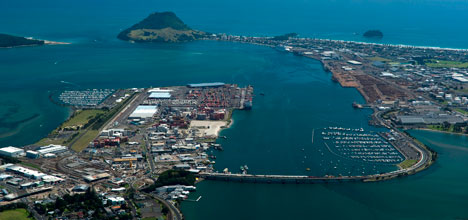
A think tank involving upper North Island councils including Tauranga City Council is refocusing its efforts on transport to improve freight efficiencies.
UNISA - Upper North Island Strategic Alliance - includes Tauranga, Hamilton and Auckland city councils and Bay of Plenty, Waikato and Northland regional councils and Whangarei District Council.
It is collaborating with Auckland Transport, KiwiRail and the New Zealand Transport Agency on initiatives to reduce the cost of doing business in New Zealand's upper North Island.
The upper North Island generates more than 50 per cent of the country's gross domestic product, and more than 55 per cent of the country's freight travels through the Northland, Auckland, Waikato and Bay of Plenty regions.
'This collaboration is crucial for ensuring all organisations are on the same page with regards to land use, infrastructure and development and we expect that working together alongside industry will further enhance the economic performance of the upper North Island,” says BOP regional council chairman John Cronin.
'Co-ordinated planning of key inter-regional road and rail links is critical to making supply chains more efficient and lifting the economic performance of New Zealand as a whole.”
More than a third of Bay of Plenty freight, 35 per cent, moves to and from other regions in the upper North Island, much of it through the Port of Tauranga as New Zealand's largest export port.
The UNISA regions comprise the bulk of New Zealand's economy and its GDP is growing slightly ahead of the national average.
In 2010, the upper North Island population was estimated at 2.3million, 52.7 per cent of the national total. Population growth within UNISA regions accounted for 72 per cent of total population growth in New Zealand from 1996 to 2010. Auckland has been the key driver for the population growth.
All of the world's most productive cities are at least twice the size of Auckland, and the challenge facing UNISA is achieving economic scale by increasing the upper north island contribution and growing it in a way that benefits all residents.
A fair bit is known about the economic strengths and opportunities within each of the UNISA member areas, but a clear understanding of the strengths of the UNI as an ‘economic district' is relatively unknown.
A recent report titled 'Economic Linkages between New Zealand Cities: Final Report” finds that the degree of economic inter-linkage between Auckland, Hamilton and Tauranga is negligible, although there are significant freight linkages between Auckland and Tauranga.
By international standards the three cities are economically distant, and the report findings suggest that improving accessibility and connectivity within the cities may have greater economic impact than trying to improve accessibility between cities.

7 comments
Core Business?
Posted on 05-07-2012 15:17 | By tibs
I'd have thought the best people to improve supply chains would be those involved in them. Mainfreight, Toll, United, Linfox, to name just a few and of course the redoubtable NZ Rail. Councillors have other things to worry about, like dinghies on the harbor beach, Len's railway set in Auckland and crime in the Hamiltron. What is economic interlinkage? Or is it just jargon that we mere mortals could never hope to understand and should we stand aside while those we elect for LOCAL bodies and those we support, their bureaucracy. No doubt there'll be expenses involved, not least the mayoral compensation for all those long trips in his new small car. If they have the resources to get involved in this sort of thing without community consultation, then they have too much power and to free an access to resources.
Are think tanks and councils mutually exclusive?
Posted on 05-07-2012 17:29 | By Gee Really
Councils love to throw around jargon like "Smart" and "think" etc, but very little of what they achieve gives us much confidence. This sounds like an excuse to employ staff and consultants.
CONTRADICTION
Posted on 05-07-2012 21:13 | By PLONKER
Improvement and Council, in fact the contradiction is actually worse because more than one Council involved. I have a hint / helpful suggestion here. The Eastern Arterial would be better going over the Kaimais ...
YES TIBS
Posted on 05-07-2012 21:36 | By PLONKER
The reason the transport is congested is because NZTA and Councils have the hand on the purse strings so meaningless is always ahead of useful and efficient. To change that means less jobs warming seats thinking about the mess created.
Apparently
Posted on 06-07-2012 13:20 | By tibs
Apparently there are only three of us concerned out of all the usual submitters here and the Tauranga voters in general. Perhaps the majority are comforted by the touchy feely Council get togethers that we get to finance. @ Plonker the NZTA can be brought into line by government but the councils.... we think we can influence things very three years but only so much.
GEE REALLY
Posted on 12-07-2012 13:59 | By YOGI
The plan of "think" and Smart" are concepts that allude them, the employ ever more people in the hope that the combined mental capacity of the group will improve however that is not so, even the learned PM Muldoon noted the obvious when saying "All the NZers leaving to OZ will increase the IQ on both sides of the Tasman..." the same applies herebut sadly for ratepayers/taxpayers the gap will never close.
TIBS
Posted on 13-07-2012 17:04 | By YOGI
I agree about NZTA can be kept in line by Govt, but Councils are generally out of control and some, there is nothing to stop the mad and crazy decisions being made and a big part of that is the lack of public awareness and comment before it is to late, i.e. the Hot Pools redevelopment and the blow out on the repairs costs. At the end of the day when all goes to custard, the ratepayers can be levied a share of the debt of Council that then needs to be paid personally by each and every ratepayer. That day is coming your way soon.
Leave a Comment
You must be logged in to make a comment.