


The Western Bay of Plenty District Council's finances are in the black with a surplus of approximately $14.78 million, thanks to three years' of tough financial management including a reduction in staff.
Mayor Ross Paterson says the while the result is pleasing it won't mean relaxation of council's tight control on spending or lower rates for ratepayers.
The surplus isn't money in the bank either. The increase of almost $5million over forecast is the surplus after non-cash items are accounted for and it has been used to fund capital works. Council in fact experienced in drop in income of $872,000.
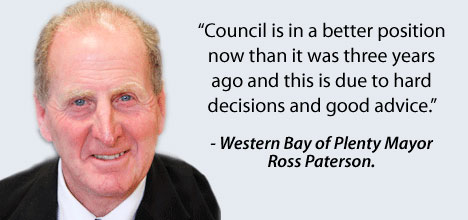
'Council is in a better position now than it was three years ago and this is due to hard decisions and good advice we have had to date. It has been a tough time and I am pleased we have weathered the storm,” says Ross.
'By maintaining a positive operating cash flow for the past year we have managed to keep out net debt $5.63million lower than forecast.”
Fewer consultants are being used and council's cash flow of $27.48million from operating activities was $3.68million higher than forecast, reflecting the reduction in operating costs.
Operating costs for the year were $7.78million lower than the full year budget of $42.46million and actual capital expenditure was $2.27million lower than budgeted.
Staff numbers have fallen by 22 from 161 to 139.
'There have been a small number of redundancies but most is as a result of not replacing people when they leave,” says Ross.
'Staff are working hard, but they are kept well informed of council's position and understand the need for the measure we have taken.”
An increase in small scale subdivision activity, much of it encouraged by council offering developers a deferred payment option, has resulted in $4.9million in financial contributions, $1.8million higher than forecast.
Even the Rena had a positive impact on council's books in the form of the recovery of costs from council's initial response to the ship's grounding.
Other positives are higher rental income from corporate asset leases, GST adjustments and savings in interest since council joined the New Zealand Local Government Funding Agency (LGFA), which has given it access of lower interest rates on borrowing.
Ross says council has no plans for new large capital works in the near future, now that the $14.5million Maketu and Little Waihi Community Wastewater Scheme is complete. That project was finished on time and within budget through a Government subsidy of $11.6million.
Council's rate increase for the 2012/2013 year is 4.7 per cent, of which 3.8 per cent is the result of inflation, leaving 0.9 per cent increase in real rates for the average ratepayer. Council's income from its 20,054 ratepayers is $47.96 million annually.
Like property owners throughout the region, council has also been hit by a decrease in land values. There has been a 24 per cent fall in value (approximately $88.6million) of council owned land and 8 per cent or $3 million fall in building values.
'While this change in asset values is a non-cash effect, it still has to be accounted for in the council's summary income statement for the year and effects income to assets as well as debt to asset ratio.”
Ross says council's income is unlikely to increase significantly in the next three years as the district and the country continues to experience the impacts of the global financial crisis.
'The region's growth is predicted to be 0.9 per cent over the next three years, which is very different from the rate of 2.5 per cent in the 1990s when this region was one of the fastest growing in the country.”
That slow-down in growth is reflected in a reduction in subdivision development and Ross says there are no large new urban or commercial projects planned by developers in the near future.
'Having just signed off the 10 Year Plan based on this fiscal approach, council has made the decision that we will be sticking by in the longer term.”
However, Ross says while the current tight fiscal policy is right for these tough times, when the world economy improves and growth returns to the Western Bay, council will need to once again turn its attention to building the infrastructure the region will require.

7 comments
Addressing the issues
Posted on 04-09-2012 12:03 | By avon
This really is a good news story. Any Council with the courage to reduce staff numbers by close to 14% has to be commended. The nature of Local Government finances shows that staff costs are the biggest council cost, and if we are to control future rate increases we have to address productivity - and it seems the Western Bay has done this. It appears to be a job "well done". Andrew von Dadelszen
So, who exactly are these people?
Posted on 04-09-2012 13:20 | By PeteDashwood
I see I contribute to them on my Rates invoices but I know very little about them. We have a City Council which is nowhere near so astute, can we get a skills transfer going on? Could somebody give me a simple clear explanation of why we need to support two local bureaucracies (not to mention Gevernment as well)? While I'm not quibbling that they have posted a "good result", how is their existence justified, please? Sure, a local authority understands local issues which are not really the preserve of Government, but why two local authorities? If they have cut staff and achieved a good result, why not cut 100% of the staff and achieve an even better one? Anybody?
fire tauranga council and get these guys....
Posted on 04-09-2012 13:44 | By wreck1080
Nice job. Tauranga council needs to take a few lessons.
Fewer consultants used
Posted on 05-09-2012 07:56 | By nothingwrongwithgreen
This probably had something to do with it too....
@ PeteDashwood
Posted on 05-09-2012 08:57 | By SpeakUp
Fair enough questions. But we all know the answer. To ask bureaucracy to self-annihilate is like asking the wolf within a flock of sheep to starve. Bureaucracy is self-generating, self-propagating, self-necessitating and self-preserving. The bigger bureaucracy (central govt.) is suffering from the unsustainable suckerdom of the smaller bureaucracy (local govt.). That's why they created something like the Local Govt Reform. The central parasites have realized that too much leeching on local level will kill their host. And central govt has also realized that you need PRODUCING people generating goods/wealth in order to maintain a well faring society compared to short-sighted welfare and gravy-train socialists. NB: the region is exploited by SEVEN various council Medusas.
AMAZING
Posted on 05-09-2012 10:15 | By YOGI
Report a surplus of over $5 million but actually they have spent it already ... like that is more like a "mirage" isn't it? Talkin all about it but really there is actually nothing there, waste of time and space and perhaps nothing better than a bit of "puff the chest" stuff with TCC to show that "what you can do we can do better ...". Bigger surplue AND spent it faster than you guys!
Correction
Posted on 05-09-2012 11:11 | By SpeakUp
Actually it's EIGHT councils we have to feed. I forgot BoP Regional Council (aka Environment BoP).
Leave a Comment
You must be logged in to make a comment.