


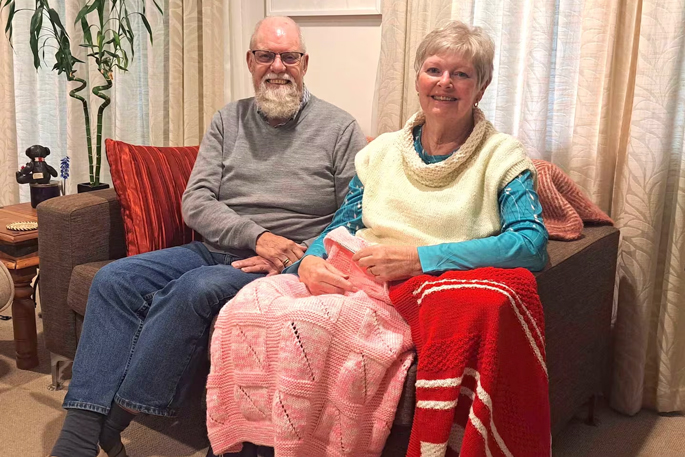
After three years battling terminal cancer, Keryn Rennie decided to stop fighting and focus on the quality of her remaining life, rather than quantity.
The Tauranga 78-year-old says she is now living as best she can, thanks to Waipuna Hospice.
She is even able to give back by knitting hats and blankets to fundraise for the “incredible” service, which faces an $8.1 million funding shortfall.
Its chief executive wants the Government to step up funding and ensure hospices survive for those who need them.
Rennie’s battle began in February 2022. A diagnosis of stage three bowel cancer quickly progressed to stage four.
She went through four radiation treatments and the cancer was successfully removed.
However, four months later, five lesions were found on her lungs.
“Unfortunately I was told it was also stage four cancer.”
Rennie said she had 32 rounds of chemotherapy and “couldn’t do it anymore”.
She and her partner of 26 years, Peter Mason, 81, decided she would stop the chemo.
“[We] chose quality over quantity, so we would have quality of life for whatever life I have left.”
After hip surgery and a heart attack last year, Mason said Rennie reached a “crisis” point.
“Trying to manage all Keryn’s medications, her mobility issues and chronic pain became unbearable for her. She was under physical and emotional attack, and it was taking a huge emotional toll on me.
“That’s when we were referred to Waipuna Hospice,” he said.
Mason has become Rennie’s full-time carer, with the support of the hospice.
Mason said they could never repay the hospice for its “completely holistic” care and support, including access to medical experts, counselling, therapists, a mindfulness coach, and equipment.
 The Waipuna Hospice care facility and head office in Te Puna. Photo / Waipuna Hospice
”They have been our salvation.”
Rennie said they were “grateful and thankful” for the hospice team.
“They have saved us several times in situations we couldn’t handle.”
Despite her prognosis, Rennie had a positive outlook.
“I’m not battling cancer. We’re not fighting cancer, we are living with cancer - and that’s a completely different mindset.
“We cannot predict - no one can - what is going to happen from here, but we’re making the most of what we have thanks to wonderful people at the hospice.”
Rennie said she believed the hospice should not have to work so hard to fundraise, and the couple donated money whenever they could.
“While I don’t have a lot of energy, if I’m sitting down, I’m usually knitting baby hats and blankets, as well as beanies … and give them to the hospice to sell in their shops.”
 Waipuna Hospice chief executive David Bryant. Photo / Waipuna Hospice
Waipuna Hospice chief executive David Bryant said the organisation was at “crisis” point with a funding shortfall of $8.1m this financial year.
His team was caring for 243 people in their homes and expected to care for about 900 patients and their loved ones this year.
Its operational costs were $14.5m a year, and the Government only funded 44%, or $6.4m.
The largest expense was wages for doctors, nurses, counsellors and therapists, he said.
An “amazing” 800-plus volunteers kept its six fundraising charity shops running.
”Despite our essential role and relieving pressure on the wider health system, we have to fight to do everything we can to bridge the funding gap."
 Waipuna Hospice chief executive David Bryant says the organisation is facing a multimillion-dollar funding shortfall. Photo / Waipuna Hospice
Bryant said he questioned whether the hospice would still exist in three years without “greater government investment in social wellbeing.”
“The government needs to better recognise that dying is part of the health system and everyone has a right to die with dignity and be made to feel safe, well-supported and not alone.”
The hospice would continue fighting, but its continued survival “relies on more government funding”.
 Prime Minister Christopher Luxon and Infrastructure Minister Chris Bishop post cabinet press conference in the Beehive Theaterette at Parliament in Wellington. Photo / Mark Mitchell
In Tauranga on Friday, the Bay of Plenty Times asked Prime Minister Christopher Luxon whether there would be more money in the Budget for palliative care services.
Luxon said he was not able to comment about the Budget’s specifics.
“But what you can know and have seen in this Government is spending more on healthcare than any other government before us.
“We spend $30 billion a year on healthcare, and in the last Budget, we committed almost $17 billion more, that’s a record amount...”
He said it could be reasonably expected there would be more money for health in this year’s Budget, due to be revealed on May 22.
Health Minister Simeon Brown was also approached for comment.

0 comments
Leave a Comment
You must be logged in to make a comment.