


A local recycling initiative has achieved a major milestone: funding the planting of more than 1000 native trees across New Zealand.
Cans for Trees, voluntarily run by Kim McGrouther, reached this goal on May 10, five and a half years after its December 2019 inception. This is well ahead of schedule.
McGrouther runs the initiative in her own time, outside her role as sustainability lead at Scion.
What began as a simple idea in December 2019 to collect and recycle aluminium cans - later expanding into salvaging metals from e-waste - has become a powerful example of grassroots environmental action.
The concept was straightforward: collect aluminium cans, recycle them, and use the proceeds to fund native tree planting through conservation charity Trees That Count. In its first year, the initiative funded just 20 trees. Today, it supports more than 400 annually, pushing the total past 1000.
About 10kg of aluminium – or about 670 cans – equates to one tree. Monthly collections now reach up to 1300 cans, gathered from across the motu, from roadside pickups to party clean-ups in Murupara.
“We thought it might take 10 years to reach 1000 trees,” McGrouther said. “But the momentum has been incredible.”
She credited the success to a strong sense of purpose and the belief that even small actions such as picking up a can have the potential to lead to lasting change.
Cans, however, were just the beginning. Kim has expanded the project into urban mining - salvaging metals from broken electronics that would otherwise be sent to landfill.
To date, she has delivered nearly 4.8 tonnes of scrap metal to Macaulay’s Metals, all transported in a Toyota Corolla.
Each evening, she spends hours dismantling old machines by hand, recovering copper, aluminium and stainless steel.
“I love figuring out how these machines work,” she said. “Pulling them apart to their finest details is really satisfying.”
For McGrouther, this is about ethical restoration as well as recycling.
“When you understand the human cost of copper mining in places such as Congo, you start to see waste differently. This movement asks us to respect even the smallest wire, to recognise the energy and resources behind what we throw away.”
One of her most significant recoveries came from a decommissioned Scion sensor network, where she recovered 88kg of copper by stripping 12km of electrical wire – a painstaking task, all completed in her spare time.
Her long-term vision includes a community Take-Apart Club, where people come together to give old technology a second, third or fourth life.
McGrouther’s environmental work also extends to local waterways.
What began as a simple streamside clean-up evolved into a 13-month survey of rubbish along 1.2km of Lake Rotorua’s shoreline. Every month, she walked the same path, collecting and categorising waste to contribute data to Keep New Zealand Beautiful.
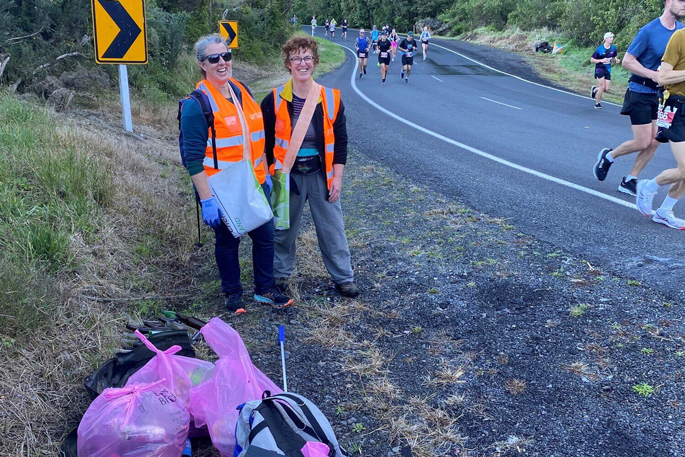
Today, she returns annually to clean the shoreline during the Rotorua Marathon.
This year, a team of 10 collected 160kg of rubbish and 120kg of recyclables over four hours.
“What we dump on our roads doesn’t disappear,” she says. “Stormwater doesn’t just carry rain – it carries every bit of litter into our lakes.”
One item that still haunts her: a plastic cap last manufactured in the 1980s. “Our lakes hold onto what they’re given. It can take a major storm or just the right winds to bring it back to the surface.”
Through it all, McGrouther remains driven by a simple message: value isn’t just in what we use – it’s in what we choose to save.
-Contributed content

1 comment
A great message
Posted on 04-06-2025 16:41 | By Watchdog
Thank you Kim, Heidi and others. A good reminder to look out where we place our plastic and other recyclable items.
And a worthy cause replanting with natives, especially.
Leave a Comment
You must be logged in to make a comment.