


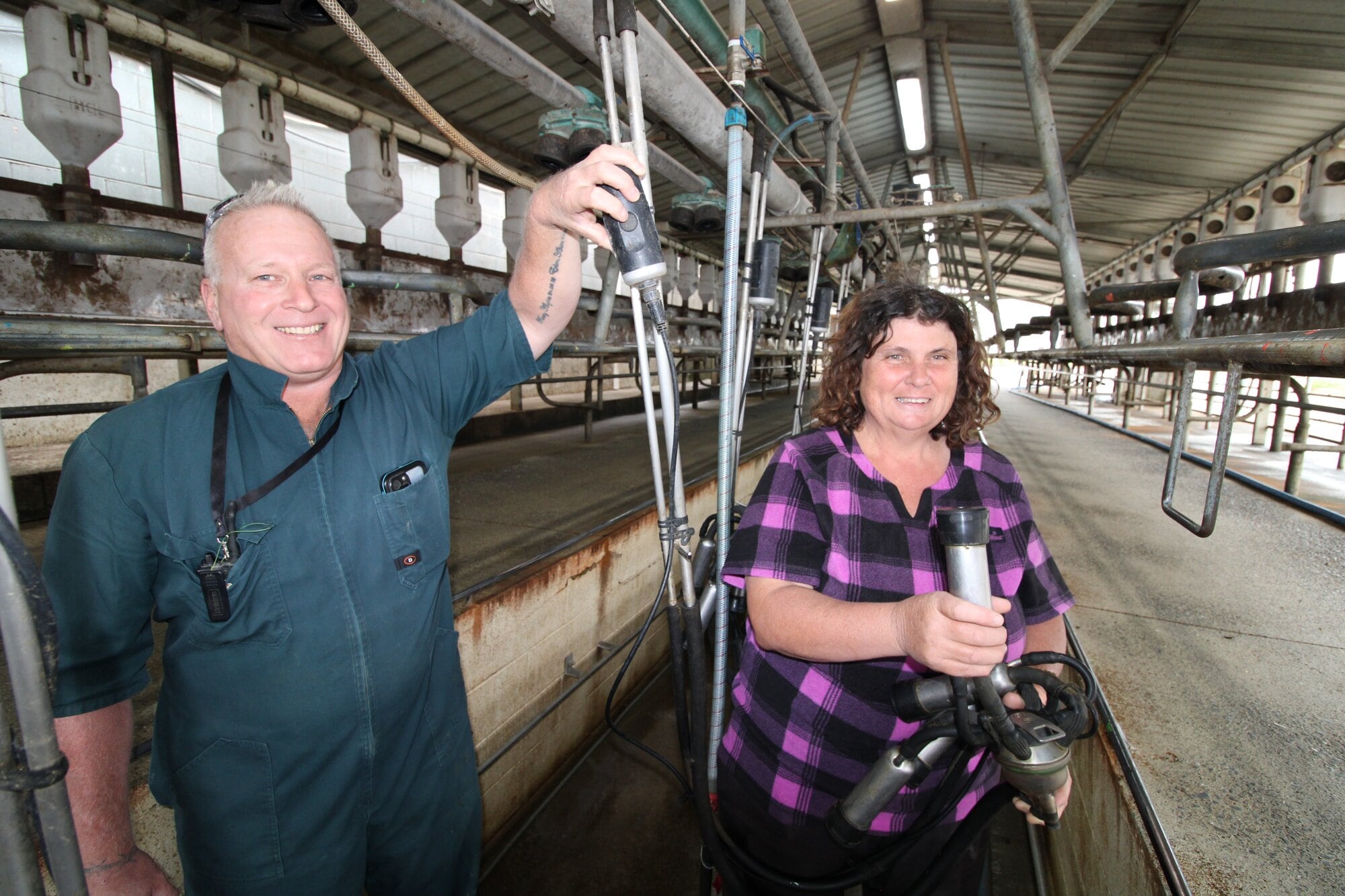
A Bay of Plenty company has gone from pipe and paper to cutting-edge mastitis detection technology.
Bovonic, which started life in the garage of founder Liam Kampshof, is signing up dairy farmers around the country for its QuadSense system.
Liam says QuadSense incorporates a milking sensor in each cup liner, allowing it to test each quarter individually rather than the entire cluster.
“It’s a small sensor that farmers can install themselves by simply cutting the liner and inserting the sensor and it runs on AA batteries, eliminating the need for an electrician.”
QuadSense starts measuring milk as soon as the cups are on, then gives a result after just a minute, he says.
“It can be installed by farmers into any milking cup liner and gives a red-light alert when mastitis is present.”
DairyNZ senior animal care specialist Penny Timmer-Arends says mastitis - inflammation of the mammary gland (udder) in dairy cows – is the costliest disease in the industry, estimated at $180 million per year.
This inflammation can result from infection or injury, but it is most commonly associated with bacterial infections, she says.
“Mastitis leads to substantial financial losses for farmers due to discarded milk, veterinary costs, increased culling, reduced milk production, and penalties for poor milk quality.
Timmer-Arends says mastitis affects udder health and milk quality, which impacts both farm productivity and profitability, so a focus on prevention, identification and treatment is important for a healthy herd.
“We encourage farmers to work with their farm vet and farm team to develop a management and prevention plan for mastitis, suitable for their herd,” she says.
From a dairy farming background in the Bay of Plenty, Liam Kampshof launched Bovonic in 2021 and featured a prototype of QuadSense at Fieldays that year.
“I started with a prototype made from a Bunnings’ pipe and a 3D-printed sensor,” he says.
Between 1700 and 1800 QuadSense units have now been installed on about 70 farms across the country including the Bay of Plenty, Waikato, Taranaki, Palmerston North and Southland.
Waikato farmer Geoff Sutherland has been using Quadsense since November.
Sutherland is a 50/50 sharemilker on a 320ha block split into three units, near Matamata, running a total of 940 cows.
Quadsense is used in a 30-a-side herringbone shed milking 470 cows on a 150ha property.
Geoff says he read about Quadsense online last year.
“Stripping [manually removing the first few streams of milk from each teat before the milking machine is attached to detect signs of mastitis] is always a curse.”
Subclinical mastitis, which has no visible signs on the udder or teats, was identified in a number of cows in the herd.
Geoff says if mastitis is detected, Quadsense “lights up” to indicate which animal is affected at the start of milking.
A phone app is used by milking staff to record alerts via the cow’s ear tag number.
A sample is taken from each of the four quarters and “grown” on agar plates. Photographs are sent to Farm Medix in Hamilton for analysis.
“We can pick up cases we had not suspected,” says Sutherland. “It’s just like an early indicator.”
Treatment of cows identified with mastitis is undertaken via veterinary advice.
If antibiotics are used, cows are milked separately and their milk withheld from collection and processing.
Dairy companies both reward and penalise suppliers for low or high mastitis levels.
Liam Kampshof left the farm leased by his family to study biomedical engineering at Auckland University, then spent four and a half years working in the human medical field in London, developing tools for detecting cancer and septicaemia.
He understood that mastitis was the most significant disease affecting farmers, prompting him to investigate how it was currently detected and diagnosed.
“I was quite surprised to discover how outdated mastitis detection methods were for most farmers,” he says.
“They were relying on manual techniques, and the available technologies were on the expensive side. I knew there had to be a way to make automation more accessible.”
He embarked on his journey into product development, leading to the establishment of Bovonic and the creation of QuadSense.
The sensors measure the conductivity of the milk – an increase in salt (sodium and chloride) concentration that occurs with infection.
Liam says this allows the determination of subclinical and clinical mastitis in advance of visible changes in foremilk or udder tissue
“Conductivity detects mastitis two or more milkings before visible signs become apparent.”
QuadSense trials are being conducted on five farms in the United Kingdom and Ireland following visits by Liam in July, October and February.
He says the company is hoping to start sales there later in the year.

0 comments
Leave a Comment
You must be logged in to make a comment.