


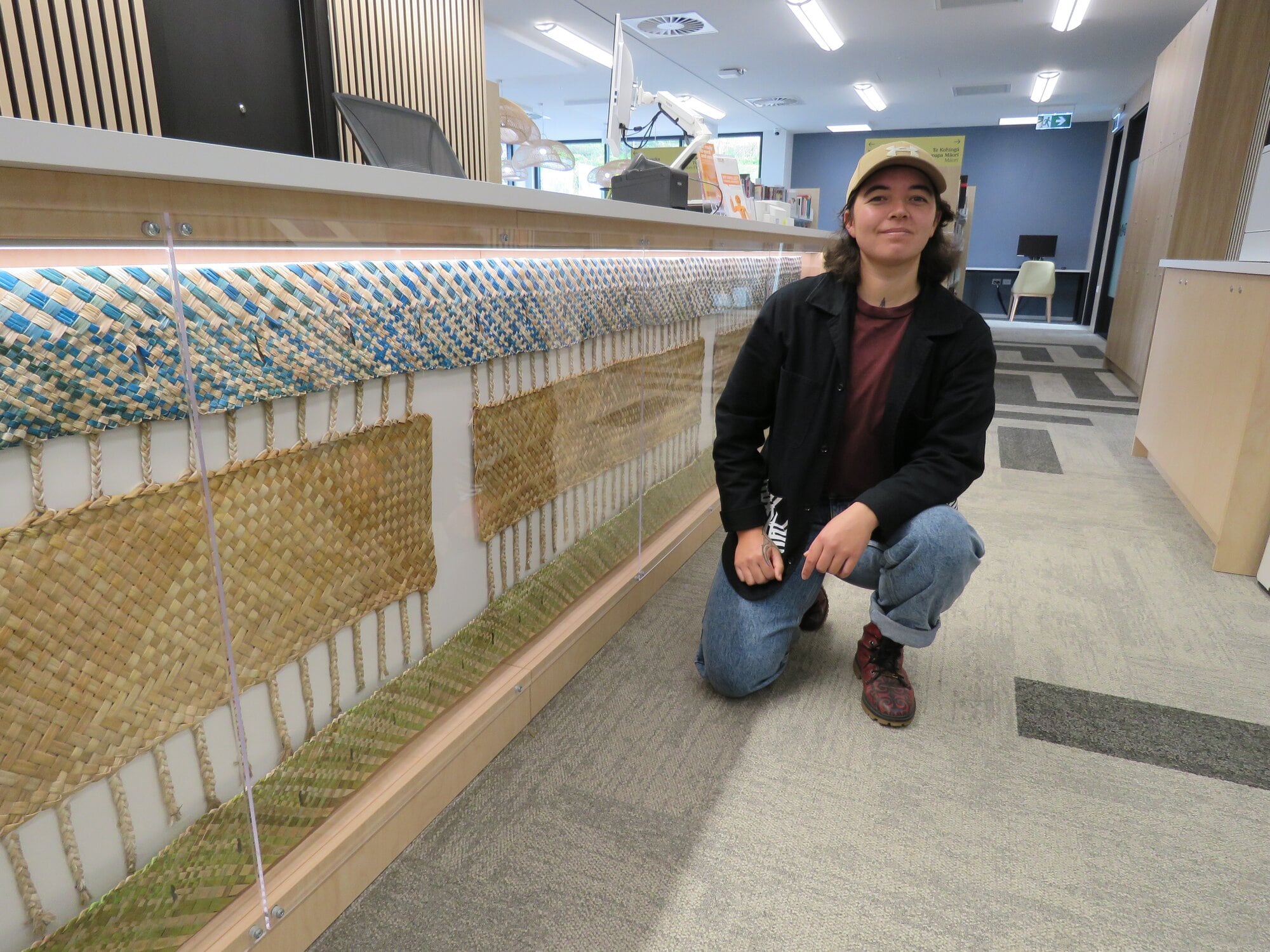
As people enter Te Ara Mātauranga, Waihī Beach’s new library, service centre and community hub, they are greeted by a large harakeke weaving with a powerful message.
Kairāranga (weaver) Marino Magee, who grew up in Athenree, said they made the piece to inspire the next generation of kaitiaki (guardians) “and get our whole community to learn, to practise our tikanga [traditional Māori values] and to advocate for our taiao [environment]”.
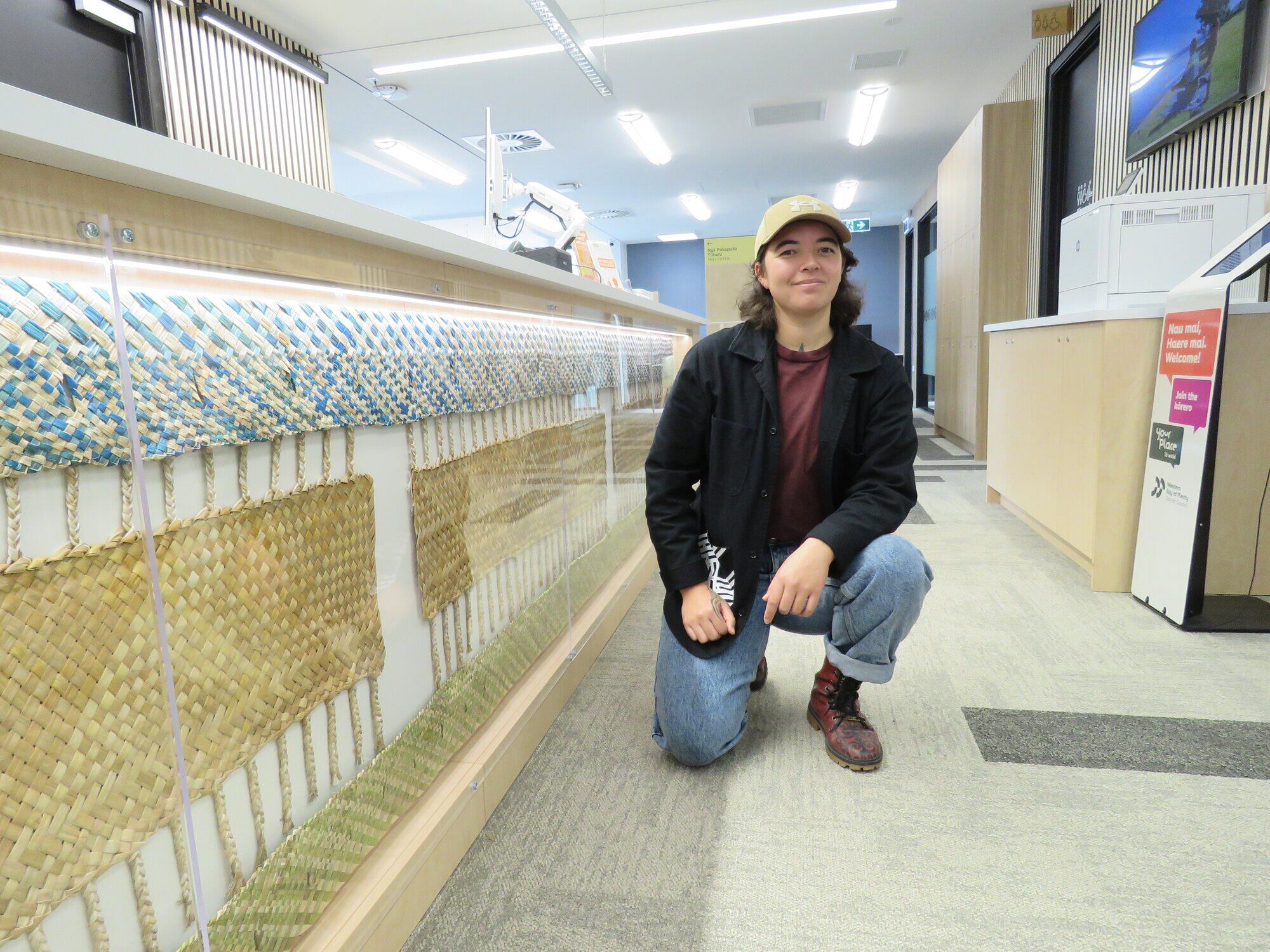
Kairāranga (weaver) Marino Magee, who grew up in Athenree, with their piece named ‘Ngā Tikanga o te Taiao’ at Waihī Beach’s new library. Photo / Merle Cave
The piece is named ‘Ngā Tikanga o te Taiao’, meaning the rules or guidelines of how we could behave and interact with our natural environment, said Magee, who currently resides in Mount Maunganui. “And I’ve tied it all together with our connections as people to the taiao.”
Three aspects
Magee said the weaving is inspired by three aspects of tikanga. They believed it best represented “our people when we come together and be in the natural environment”.
“The three tikanga are kōrero, karakia, and koha, which each have important meanings and can guide us on how we interact in the taiao.
“The top piece in blue represents Ranginui, our sky father, and the bottom piece in green represents Papatuanuku, our earth mother. In the world of Māori, these are our parents, who’ve been made to be apart so that we can exist, making us all connected to each other and especially to our environment.”
The middle
Magee said the three middle pieces are the tikanga the community could practise to not just survive “but thrive sustainably for future generations to come”.
The first, kōrero, means to talk, said Magee. “My interpretation of kōrero for this piece is before you enter the taiao, talk to people you trust about where you’re going, what you’re doing and most importantly, when you’ll be coming back.”
The second, karakia, is prayer in te ao Māori. “The reason we karakia for the taiao is to first give our thanks and acknowledgment to Ranginui and Papatuanuku for their existence and for the space we are gifted to live on today. We then thank our atua Māori for creating places like the forest and sea and all its creatures within. Karakia connects us to our spiritual wellbeing; and gets us focused on the correct mindset of the kaupapa for our day.”
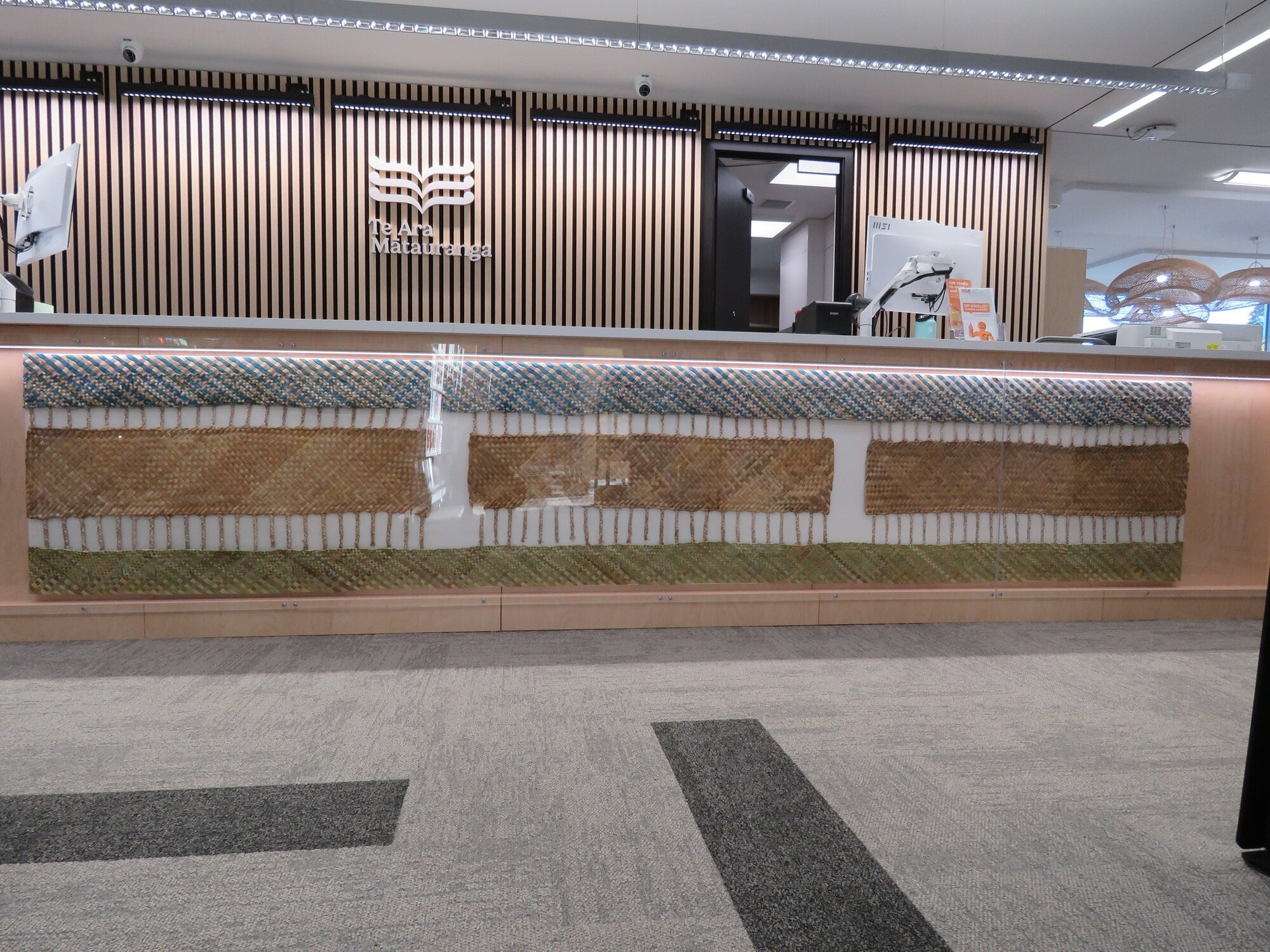
Ngā Tikanga o te Taiao’, weaved by Marino Magee, takes centre stage along the desk in Te Ara Mātauranga, Waihī Beach’s new library, service centre and community hub. Photo / Merle Cave
The last, koha, one of the most important tikanga, roughly translates to gift, said Magee. “When kaitiaki work or when they’re in the taiao, they always think of ways to give back – like picking up rubbish, water monitoring or planting trees.
“Even when they collect kai from our taiao, a kaitiaki will leave the baby and its parents of all creatures; they will leave the smaller pipi and mussels, give back their first fish or leave enough flowers and berries on a tree for the birds and the bees.”
This is to look after the taiao but also ensure creatures people rely on for kai continue living alongside them, Magee said.
The plaits in between represent all people and our connection to our taiao. “I’ve entwined muka, signifying our spiritual connection inside all of us, just like the muka you find inside the harakeke leaf I’ve extracted to show a beautiful white fiberous string, tying us all together as one.”
Growing up
The weaving takes centre stage in the new facility for the community where Magee grew up. “I went to kōhanga at Ōtāwhiwhi, Waihī Beach for primary school and finished at Waihi College.”
The 24-year-old grew up around weaving. “Ever since you’re young at kōhanga [reo] you do weaving pieces. My mum [Kararaina Sydney] has also always been interested in a raranga [traditional Māori weaving].”
After college, Magee donated a woven piece to their primary school. “It’s a bright yellow piece worn over the shoulders of the lead boy in the Waihī Beach school kapa haka group.”
This piece was worn by Waihī Beach primary student Hunter Wilson, 9, at the opening of Te Ara Mātauranga on July 1.
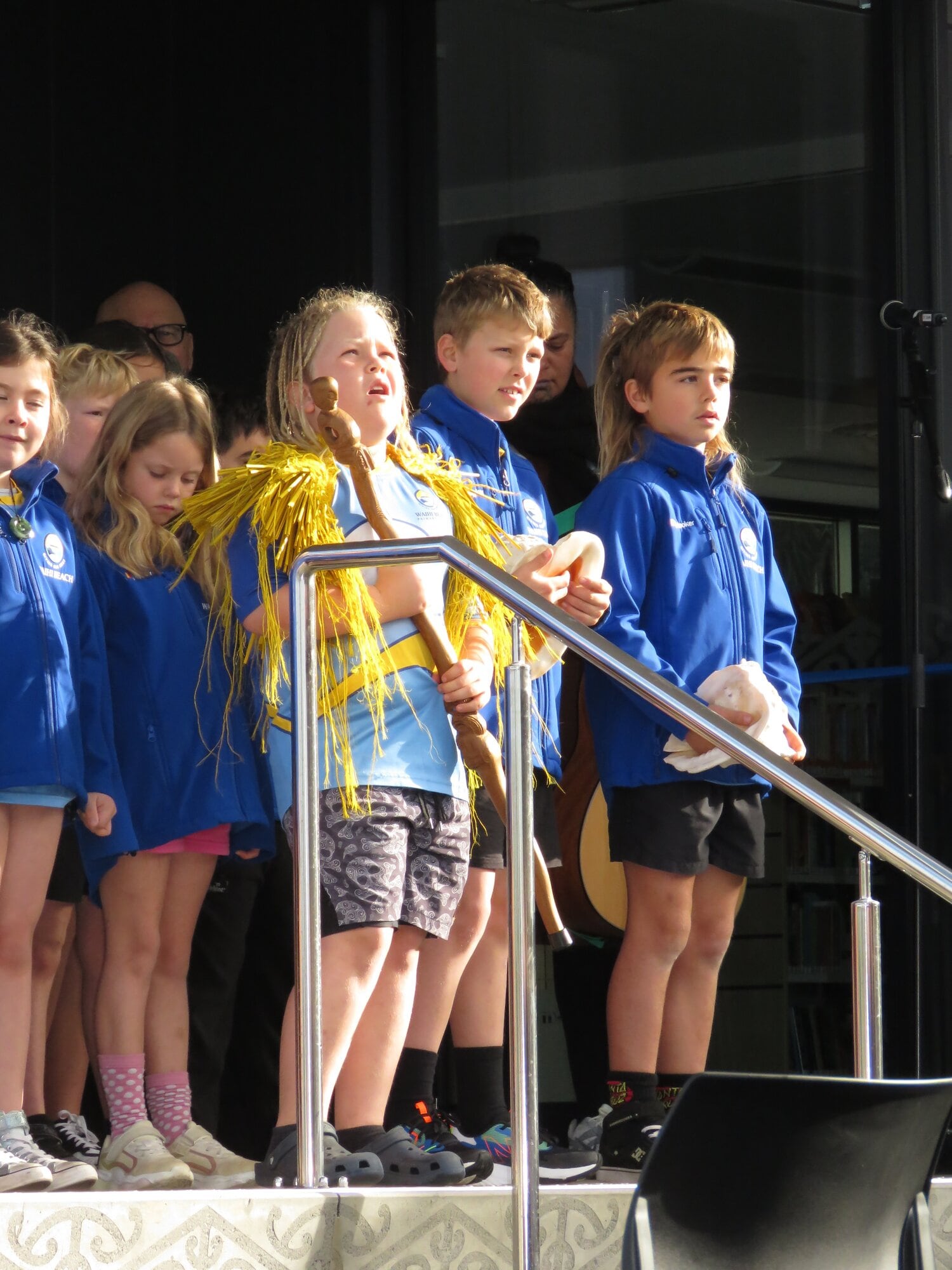
Waihī Beach primary student Hunter Wilson, 9, wore the woven piece, donated by Marino Magee, at the opening of Te Ara Mātauranga on July 1. Photo / Merle Cave
But Magee said it wasn’t until 2021, when they studied Level 4 and 5 Toi Paematua at Te Wānanga o Aotearoa, in Tauranga, that their passion for raranga grew.
“Level 4 covers weaving using harakeke to make kete [bags] and whāriki [mats]. Level 5 is pieces you see worn by kapa haka groups – the piupiu, keke, korowai.”
The opportunity to weave a piece for Waihī Beach’s new library had come about via community connections and luck, said Magee, who with their sisters, harvested harakeke from a spot near Bowentown under tikanga. It was a “massive” undertaking, said Magee, who harvested harakeke from five bushes.
Everything
The weaving took Magee one working week – but first they had to create the design using different patterns and techniques. “I also cut out a draft model to have a visual.” All up the project took nearly three months.
Magee said raranga is now a very big part of them. “It’s one of my major passions – the other is Māori art.” They described creating the symbolic piece for their community’s new space as “unreal”.
“It’s amazing to be born and raised in this place, to grow up how I did and to be given these opportunities; and I feel very honoured to be given this experience to be part of the beginning of the creation of my own legacy. Being allowed to imprint a piece of myself and give back in my own way to my own community, it was everything.”

0 comments
Leave a Comment
You must be logged in to make a comment.