


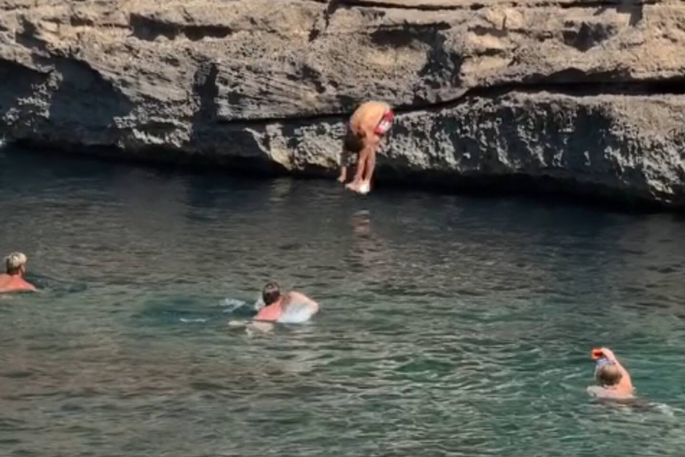
When Tauranga's Flynn Chisholm leapt from a scenic cliff top in Majorca last week, it took him less than three seconds to achieve what no other Kiwi had.
The 40m “death dive” sent him face down into the Balearic Sea and headfirst into the high diving record books.
“I’m the highest classic, like no tricks - just straight staple [called a døds dive], the highest in New Zealand and Oceania,” said Chisholm.
The 2.9 seconds it took to ride gravity from ledge to ocean belies the length of time that the thrill seeker had put into his preparation.
“I didn’t know it was going to be exactly that cliff, but I’ve been prepping this whole year and specifically the last month. I’ve been doing many high jumps to prepare for the impact of 40m,” said Chisholm.
Forty metres is roughly the height of a 12-story building. Chisholm estimates his speed at impact was “three figures” or upward of 100km/h.
“I don’t even know how to describe hitting the water at that speed. You’re closing with your arms above your head and usually they just get shot back because the impact is just so big it throws your arms back, but this time I managed to punch right through the water,” says Chisholm struggling to do justice to the physical pressures that death divers’ experience.
How exactly do you prepare for that sort of collision with nature?
“I kind of apply like other sports’ science. Just like MMA, I try to condition my body through impacts. I think I’ve done maybe six or seven 30m jumps, and close to 35 20m-30m jumps. That’s just getting my body ready for the impact and used to airtime - ‘air awareness’. I believe to get better you’ve just got to do it a lot, like any other sport,” said Chisholm.
He described the impact from his record-breaking jump as “a little bit softer than I thought” and estimated an entry depth of just 2m.
“Last year I broke the record, jumping 35m in New Zealand. That impact was huge. I trained a lot for it, but I wasn’t used to it. I had done 34m two days prior [to Majorca], and that was a lot heavier.”
 Tauranga's Flynn Chisholm checks out Whangārei Falls ahead of his death dive from the fence top of the platform at the top of the cliff 30m above him.
The 20-year-old has several important rituals before hurling himself into the big blue.
“I am a Christian first and foremost, so I’ll say a prayer with the group, wishing safety over the jump and everything,” said Chisholm.
His crew captured every angle of the jump for social media – as well as providing support in the water.
“I have about 10 or 12 people there.”
THE HEAD GAME - “Send it!”
The mental preparation began an hour prior to jumping, according to Chisholm. There were many emotions at play in his sport.
“The pure fear of just walking up the cliff is probably the worst part because you’re walking up all these steps. You’re like, ‘oh, we’re still going higher’. Right before the jump, you just feel the fear again. The unknown of what’s going to happen when you land,” said Chisholm.
In between the pangs of fear is the calm – trying to clear his mind.
“I throw rocks to visualise how long I’m going to be in the air. I usually have three rocks, and once those three rocks are thrown, I’m going behind the last one. And everyone knows that,” said Chisholm.
“As soon as I start counting down from 3, I’m totally focused and there’s no backing out. Once I say ‘send it’, I just push out as far as I can, and usually the ‘flow state’ takes over. I’m not thinking about anything at all while I’m the air, just the flight.
“You’re purely focused on just flying through the air and you’re surviving. I love that about the sport. It makes you feel really grateful for where you are.”
This ritual was repeated in Majorca – only in this instance, the pre-jump rocks weren’t hitting the water.
“My safety in the water said ‘dead’, which meant my rocks were hitting the cliff. When that was happening, I was quite nervous because I knew I had to jump really far to make the gap,” said Chisholm.
The “gap” he refers to is the distance he had to clear to ensure he hits the water and not the steep rock face.
“This was probably... I don’t want to like claim it – but, one of the gnarliest 40m jumps ever because it was like a 5m to 6m gap,” he said with a giggle.
There was an emotional transition, he said, when the adrenaline that helped him jump from a 40m cliff into the waiting waters becomes euphoria.
“As soon as I hit the water, I come out of the flow state, come up and just celebrate. It all happens so fast. When you land and you’re pain free, you get to celebrate. It’s just, I think, just the greatest feeling. It’s truly, truly amazing.”
NOW WHAT?
Waiting for him at the bottom of that Majorca cliff was his support crew.
“My girlfriend was on the side, so I got to give her a hug straight away,” said Chisholm.
Those who shared the moment with him, other cliff jumpers, understood what Chisholm had just achieved. Among the support crew of half a dozen that were in the water was the current world record holder – German jumper Florian “Chucko”.
The title holder recently jumped 48.7m from the top of a waterfall. The world record is not something that has been on Chisholm’s radar – until his latest achievement. Now it’s under consideration.
“I’ve been telling people the only way I would go for it is if I had funding to only train. I think I could do it if I could get a sponsor to help me. Pay to train and search spots to be able to do it, I think I could do it like that,” said the Tauranga product.
“MUM HATES IT”
Chisholm was relatively new to death diving. He only picked it up around the time that Norway’s Ken Stornes made global headlines for plunging 40.5m into icy water in 2023.
“Probably two New Zealand summers ago. I liked jumping off cliffs, I guess. Not like I am now, but just for fun. And I was never good at flips - so I found this new style on YouTube and I started doing it. Now, like, I just love it.”
Chisholm has jumped from countless spots around the North Island.
“Taupo, Rotorua, Hamilton, the Waikato River is like - I’ll scroll on Google Maps and that’s how I find a lot of my spots.”
Ironically, the death diver – who has qualified to dive at the World Championships in Tobago - is also a world class speed climber. Currently in Valencia, he’s heading to a World Games speed climbing event in China before he returns home to continue diving.
“I’m holding a New Zealand tour in September. I’m gonna film a døds movie. It’s called Døds Unplugged and that’s hopefully gonna showcase a lot of New Zealand spots and how we go about jumping,” said Chisholm.
The “how” was important to him – and his family. Watching your son leap from the equivalent of a 12-story building at speeds usually seen on a motorway isn’t every parent’s dream.
“My dad, he doesn’t mind it. He likes that I’m trying to be different and take a different approach. I’m not being reckless, I’m trying to promote this in a safe way, and I’m doing it in a safe way by training a lot.”
Still, he said his dad “can’t watch”.
“My mum hates it, which I can understand,” said Chisholm.
His social media followers clearly love it. He has more than 20,000 followers on Instagram and one video alone has been viewed more than 34 million times.
He hoped potential sponsors also find it hard to look away.
“High diving is perfect for Red Bull New Zealand. I love the outdoors and adventuring New Zealand, so I’m trying to get outdoor brands to generate some funding so I can just explore New Zealand’s waterfalls and fjords down south and just find unjumped rock cliffs.”
Mike Thorpe is a senior multimedia journalist for the Herald, based in Christchurch. He has been a broadcast journalist across television and radio for 20 years and joined the Herald in August 2024.

1 comment
Hmmm
Posted on 14-08-2025 15:52 | By Let's get real
Yet another word that has been corrupted... Sport.!!
I object to this sort of activity gaining any publicity whatsoever. It might lead to more deaths and serious injuries around the country in public spaces.
What is the reason behind this activity being banned from public swimming pools, but it's perfectly acceptable from bridges, wharves and waterfalls..?
This and many other brainless activities should be banned by ACC and funding for publicly funded healthcare should be withdrawn.
Leave a Comment
You must be logged in to make a comment.