


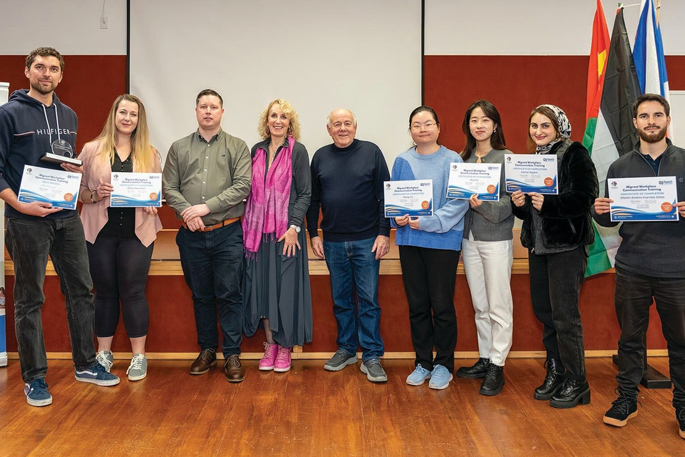
A workplace communication training programme is making a meaningful impact on Tauranga’s growing migrant community by helping participants gain confidence, improve job prospects and strengthen their connection to life in New Zealand.
Six Tauranga-based migrants recently completed a 10-week course run by Multicultural Tauranga, earning a ‘Certificate in Professional Speaking’ through Speech NZ.
The course, now renamed Migrant Workplace Communication Training, is designed to empower non-native English speakers with practical communication skills essential for the New Zealand workplace.
Delivered in a hybrid format – both online and in-person – the revamped programme was fully-funded by Multicultural Tauranga, with assessment costs supported by the Community Organisations Grant Scheme (COGS) Tauranga Moana.
Speech NZ executive manager Helena Coulton said that although the course had been offered since 2017, a name-change and format update in 2024 were critical to its renewed success.
“The original title – Professional Speaking for Migrants – was often misunderstood,” said Coulton. “Many migrants felt it wasn’t relevant to them because they didn’t see themselves giving presentations or becoming managers. But the communication skills taught in the course are useful at every level of employment. It’s about building confidence.”
The six participants, originally from China, Chile, the Czech Republic, and Palestine, came from a variety of backgrounds. Some were new arrivals to New Zealand; others had lived here for years.
Their professional roles ranged from transport and administration to trades, student life, and volunteering.
The programme was facilitated by experienced educators Pieter de Zwart and Niall Baker, who guided participants through key workplace communication skills: speaking in job interviews, giving and receiving feedback, navigating workplace conflict, presenting to groups, and adapting tone and body language for different audiences.
“For many migrants, English isn’t the only barrier,” said Multicultural Tauranga programme coordinator Premila D’Mello. “Confidence, cultural awareness and professional communication can be the difference between surviving and thriving in a new country.”
The course culminated in an assessment, where participants delivered a workplace speech, read from a professional publication, engaged in an interview simulation, and gave a short social speech. All six successfully passed.
Participant feedback highlighted the personal and professional growth the course fosters: “to improve my English and get to know more about New Zealand culture”; “to build confidence, look more professional, and grow in my job”, and to refine communication skills such as “adjusting my tone and body language” or “polishing my pronunciation”.
For many, it was also about connection and courage: “I want to improve my English and build relationships” and “I’m thinking ahead before I speak” and “I feel more confident speaking in public and speaking English in front of other people” and “I won’t be afraid now”.
Friends and family also observed a positive shift in their personalities.
One participant, now pursuing a career in beauty therapy, said the course gave her the tools to better express herself with clients and colleagues.
“We’re incredibly proud of the participants’ commitment and growth,” said Coulton. “This programme gives people more than just communication skills – it gives them confidence, connection, and real tools for life and work in NZ.”
The course saw an uptick in engagement thanks to stronger collaboration between Speech NZ and Multicultural Tauranga.
While 15 people initially expressed interest in the course, only six were able to complete the full 10 weeks due to changes in work or living situations. Plans are under way for another Tauranga intake in 2026, and expressions of interest are now open.
Speech NZ, a national organisation supporting confident communication, also backed similar migrant training programmes in Rotorua and the Waikato.
“It’s about real community impact,” says Coulton. “We’re not just a vague persona in the background. We want to be actively connecting with communities and listening to what they need.”
For more information, visit: https://www.speechnz.co.nz/contact

0 comments
Leave a Comment
You must be logged in to make a comment.