


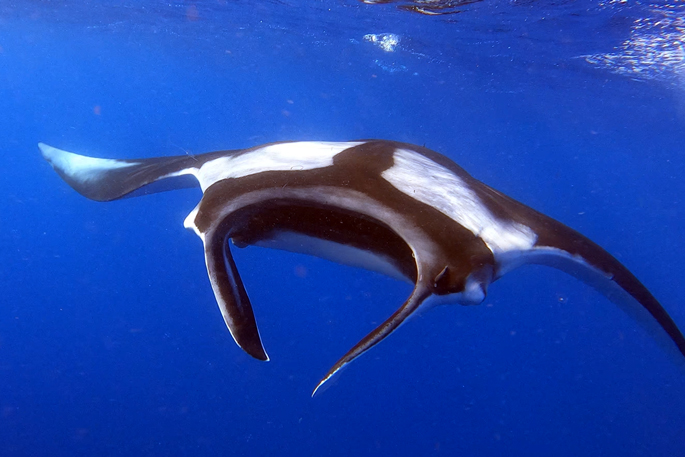
The elusive but always welcome gentle giant of the seas – te whai rahi the oceanic manta ray – has been assigned a threatened conservation status for the first time in New Zealand.
Manta rays were amongst 113 species assessed by an independent expert panel for the latest conservation status report on New Zealand’s chimaeras, sharks and rays.
The latest data shows manta rays were now ‘Threatened – Nationally Vulnerable’.
Previously, they were considered ‘Data Deficient’. This change represents a greater level of concern for the species than previously held.
DOC senior science advisor Dr Karen Middlemiss, who was a member of the expert panel, said manta rays were curious, gentle natured, and highly intelligent.
“They’re highly mobile, which is a challenge for data collection. They navigate over long distances through the Pacific region, visiting our waters to feed and breed for six months each year.”
Middlemiss said collaborative efforts to get better data on New Zealand manta rays have so far included satellite tracking studies and photo-identification of individuals. DOC, Manta Watch NZ and Conservation International NZ have partnered on this work.
“Boat strike and plastic pollution are a problem for them. In fact, researchers have found around 30% of the manta rays photographed showed signs of injuries likely caused by human activity.
“Raising awareness that manta rays spend from spring through to early autumn each year in New Zealand’s coastal waters can help, and we urge boaties to keep a lookout for them.”
Middlemiss said manta ray population estimates were thought to be around a few thousand in New Zealand, but data was needed to confirm this.
“We know very little about our manta ray population size, age structure, and regional connectivity with other Pacific populations.”
Other threatened species
Basking and Plunket’s sharks were now ‘Threatened – Nationally Critical’ – the last status before extinction.
Basking sharks were seen in large schools along our coastline until the mid-1990s and Plunket’s sharks have also suffered large declines since that time.
“The disappearance of the basking shark from New Zealand’s shores is very concerning, and we don’t know exactly why this has happened,” Middlemiss said.
“Urgent research is required to better understand population pressures – both human induced and environmental – to inform conservation management decisions for both basking and Plunket’s sharks.”
Frill sharks, southern Mandarin dog fishes, goblin sharks and smalltooth sand tigers have all improved in status, reflecting better information on the extent of their habitat and greater protection from the closure of the Kermadec Ridge and parts of Lord Howe Ridge and Norfolk Ridge to trawl fishing.
Middlemiss said people could help all marine species by being “citizen scientists”.
DOC encourages the public to report details of sightings, captures or strandings of protected sharks, rays or chimaeras to sharks@doc.govt.nz or 0800 DOC HOT (362 468).
Protected species identification guides ere available on DOC’s website to help identify sea life.
“You can also take part in naturing for our native species by downloading the Spyfish Aotearoa app, which invites people to watch short clips of underwater footage in New Zealand’s marine reserves and count and identify fish species. Your input will directly contribute to scientific research,” Middlemiss said.
-Content supplied by DOC

0 comments
Leave a Comment
You must be logged in to make a comment.