


By RNZ
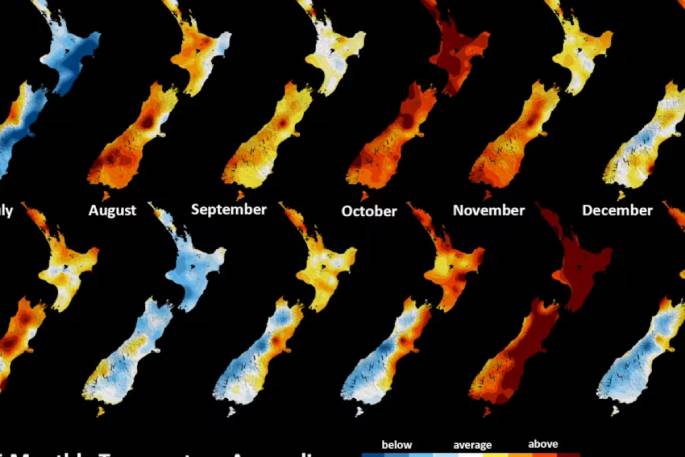
2025 was the country’s fourth-hottest year on record, according to Earth Sciences New Zealand’s annual climate report.
The report found that most regions were hotter than average by between 0.51 and 1.20C, but parts of Northland and Bay of Plenty were significantly hotter, by more than 1.2C.
Leigh, north of Auckland, recorded the highest annual average temperature across the mainland at 17.7C, followed by Kaitāia at 17.1, and Whangaparāoa at 16.9.
The highest air temperature of the year was 35.6C recorded at Kawerau on December 7. This was followed by 33.8C at Napier on December 8, and 33.7C at Ettrick on February 16.
The report points out: “Of the six main centres in 2025, Auckland was the warmest, Tauranga was the sunniest and wettest, Christchurch was the equal-coolest, and Dunedin was the driest, equal-coolest and least sunny.”
The organisation has recorded the annual temperature at seven weather stations across the country since 1909. The report found a nationwide average temperature of 13.51C.
 Record heat, rising sea temperatures and extreme weather characterised 2025 across New Zealand. Image / Earth Sciences NZ
Four of the five warmest years on record have occurred since 2021 because of human-induced climate change, it says.
Atmospheric carbon dioxide levels continued to rise, surpassing 423 ppm at Earth Sciences New Zealand’s (ESNZ) Baring Head monitoring station during the year.
November was the warmest on record, with most of the country more than 1.2C warmer than average.
Some regions were also much wetter than usual, with several areas of the South Island, including Nelson, Marlborough and Banks Peninsula, receiving 20 to almost 50% more rain than usual.
According to the analysis, the soil moisture level was below normal for most of the North Island and the northern part of the South for the first quarter of 2025. Soil moisture is a key indicator of droughts and is watched by farmers. By the end of winter moisture was mostly back to normal but dried out in some eastern parts through to the end of November.
The crown for the region with the highest annual sunshine went to Taranaki with 2743 hours recorded at New Plymouth. It was followed by the Nelson region (2672 hours recorded at Richmond).
 Taranaki had the highest sunshine hours at 2743. Image / Earth Sciences NZ
Sea temperatures were also on the rise.
Local sea surface temperatures were “relatively warm”, the report says, and remained pretty much above normal for the year, though there were brief cooler patches west of the North Island.
“Most notably New Zealand observed its warmest (sea surface temperatures) for November and fifth-warmest April on record.”
 Four of New Zealand’s five warmest years have all happened since 2021. Image / Earth Sciences NZ
Among the report’s other findings were:
- The highest confirmed wind gust for 2025 was 252km/h at Cape Turnagain on the east coast of the North Island on October 21
- The coldest air temperature was at Mt Cook airport on June 8, at -12.9C. The same day Lake Tekapo was -11.2C
- The wettest location, according to rain gauges, was Cropp River at the Waterfall (on the West Coast and about 975m). It recorded 10,951mm; another gauge on the Cropp River at Cropp Hut was just behind with 9925mm
- The highest temperature was recorded in December, which is uncommon for New Zealand. The last time this happened was 2015. It was 35.6C at Kawerau on December 7. The next day Napier recorded 33.6C.
– RNZ
Discover more
- Summer of 'two personalities' ahead
- 'In for a warm week': Golden spell set to push regions
- Shadow summer: The frontline workers holding up everyone
- Preparing for summer’s hottest weekend: 37C

0 comments
Leave a Comment
You must be logged in to make a comment.