


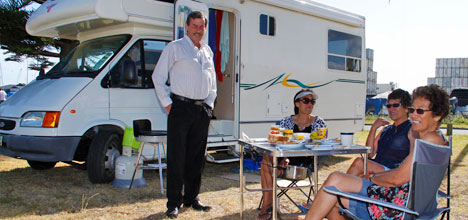
Council policy on freedom camping around Tauranga will be back on the table this afternoon when councillors attend a Strategy and Policy Committee meeting.
Tauranga City Council was forced for review its blanket ban policy after the Mobile Caravan Association informed them it was illegal under the Freedom Camping Act last year.
Tauranga City Councillor Murray Guy with a group of freedom campers.
The Council has since obtained legal advice, some of which remains confidential.
Whether a decision is made today remains uncertain. The staff supplied motions for the agenda provide bail-out, and more delay decision making options.
The heart of the issue is the relationship between the Reserves Act 1977 and the more recent Freedom Camping Act 2011.
Under the older Reserves Act the council can prosecute offenders, which is an uncertain, time consuming and expensive process.
Under the Freedom Camping Act offenders can be ticketed and fined but includes safeguards preventing councils using it as a blanket bylaw enabling them to fine anybody they choose – which is where Tauranga City Council comes unstuck.
In the city's draft Street Use and Public Places Bylaw 2012, there is a blanket ban on freedom camping in all parks and reserves in the district excluding Memorial Park; Greerton Park; Fergusson Park; Manne Park; and Waikareao Foreshore Reserve.
The basis of the legal issue relates to whether or not if freedom camping is restricted to five named street reserves tickets can only be issued on those reserves.
Any freedom campers elsewhere in the city, including any people who choose to sleep overnight in cars along Marine Parade during summer, cannot be given a $200 ticket because their freedom camping comes under the Reserves Act. They have to be prosecuted.
The council's approach also appears contrary to the Freedom Camping Act, which states camping can be prohibited or restricted if it is necessary, to protect the area; to protect the health and safety of people who visit the area; to protect access to the area.
The law of the land states freedom camping is permitted unless it is restricted or prohibited in accordance with a bylaw under the FCA. The Council's approach is entirely the opposite, banning freedom camping everywhere, except where it is expressly permitted.
Until it's resolved the council is relying on the Street Use and Public Places Bylaw 2005, which states that no person shall use any vehicle for the purpose of living accommodation on any portion of any public place, except where campervans and motor homes are permitted.
This appears to go against Section 12 of the FCA which states a local authority "may not make bylaws under [the Act] that have the effect of prohibiting freedom camping in all the local authority areas in the district."
Also in today's meeting the council will revisit its mobile shops policy. The council changed the time limit from 30 to 60 minutes in high foot traffic areas.
Because there were time limit issues, retailers were permitted to trade all day on Marine Parade to Grace Avenue, but now other Mount Maunganui retailers are complaining.
And in another piece of ad-hoc rule changing, staff are seeking council permission to change internal rules to allow them to carry out decisions made by the politicians at the first meeting of the year on January 31.
Councillors voted to make ratepayers pay for two bad financial investments, the Te Tumu land purchase, and Route K.
Neither is performing to financial expectations. The debt on the Te Tumu land purchase of 170ha is forecast to be $14 million by the end of the 2013/14 financial year. Interest is forecast to be $837,000 for the same year.
By the end of the 2014 year the loan is forecast to be 15.9 million, and the interest is expected to be about $1 million. The council paid $10 million towards the purchase in 2007. The land is now worth considerably less than it owes.
The Te Tumu land is ‘strategic property', which is separate from the rest of the council property management portfolio. But now it's lumped in with the rest of the council property, income from other properties can be used to offset some of the interest bill.
The decision to create a debt retirement charge of 4 per cent relating to the debt related to the Te Tumu land purchase is not covered in existing council policy because there is no provision for debt retirement funding within the Strategic Property activity.

8 comments
Te Tumu lands
Posted on 12-02-2013 11:47 | By YOGI
According to Council information the land is now worth $5.6 million, the total money paid by Councils was $15 million, the other $5 million is from WBOPDC so they will be suffering the same financial messes as TCC.
Councillors, just answer these simple questions
Posted on 12-02-2013 12:26 | By Phailed
If freedom camping is allowed, should it be allowed on all public land? If not, then exactly where? Is freedom camping only for those with motorhomes, or should poorer tenters be allowed provided they tent within say 100 metres of a public toilet? It's an important issue because although the fancier motorhomes have loos on board, I'm sure some fuller figured motorhomers use the public toilets rather than sideways squeeze into their onboard cubicles??
Once again.....
Posted on 12-02-2013 13:34 | By penguin
One wonders about the quality of the advice given to councillors by its advisory staff with yet another 'got it badly wrong'/ backtrack/review/'start again' episode from the council!
Keep it self contained
Posted on 12-02-2013 15:01 | By Justintime
Phailed refers only to using the toilets. Self contained vehicles also contain grey water tanks for such things as shower and dish water. They are designed to leave no trace, and use dump stations to discharge their waste. Grass also dies under tents. These are important differences.
Freedom for some maybe
Posted on 12-02-2013 16:16 | By Camperladdie
A consideration has to be made I feel to allow only self contained vehicles showing the green sticker. The smaller vans are usually the culprits leaving both human and food waste behind as happened recently. Surely it is in the interest of the shopkeepers and business owners to lobby for this as they also reap the benefit of the campers in the area. Police the freedom camping by all means giving instant fines to the bad ones but PLEASE leave the majority to come into our area and enjoy all we have to offer.
@phailed
Posted on 13-02-2013 06:17 | By SpeakUp
What do you (and most councilors) not understand in: PUBLIC land is for PUBLIC use. Existing laws against littering, camping in prime locations, public nuisance, obscene behaviour, noise control, etc. govern quite sufficiently any OTT behaviour. It doesn't matter if tent or supervan. To all know-it-all holier-than-holy sticky-beak oppressors of personal freedom: Show some common sense and stop your messianic attitude. Stop creating superfluous regulations and get back to the job you are commissioned to do. You have no mandate to curb personal freedom with pretentious and petty by-laws. Leave freedom (camping) alone and mind your own business.
Change in approach agreed
Posted on 13-02-2013 07:46 | By Murray.Guy
By majority Tauranga City Councillors have instructed staff to reverse our approach to 'freedom camping'. Rather than the blanket type bans likely illegal and unenforceable, with only 5 areas available, staff are now to identify specific areas within our city that do not support 'freedom camping'. Specifically, Council is looking to open the city up to 'self-contained mobile campers'.
@Murray Guy and @SpeakUp
Posted on 13-02-2013 09:55 | By Phailed
Cr Guy, how about you identifying specific areas within the city that do not support freedom camping? After all, that's where the whole process will succeed or fail. And why only do you cater for richer self-contained vans? What about the traditional kiwi camper (yes, a tent), provided they are near the public toilets (the same ones many self-contained campers actually use)? SpeakUp, you say there are existing laws covering camping in prime areas. Where specifically are the prime areas, and if they are still public land, doesn't your argument about freedom fall down?
Leave a Comment
You must be logged in to make a comment.