


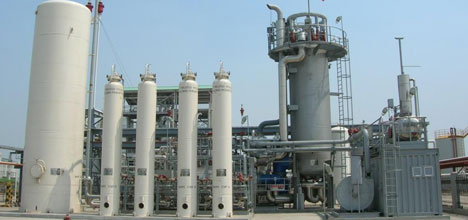
Significant funding is still needed before progress can be made on a monster waste-eating steam reformer plant in Te Puke, Tauranga City Councillors were told this week.
Te Puke Economic Development Group managing director Mark Boyle says another $150,000 is needed to complete the project plans before the group can start working out how to build, fund and supply the plant – which could provide about $27 million in annual profit.
Part of a steam reformer plant similar to the one being planned for Te Puke.
Plans are to build the plant at Rangiuru, where it will run on organic municipal waste – turning the rubbish which at present goes into the Waikato landfill into synthetic diesel.
'The whole idea really means waste reduction, decreasing the volumes going into landfill,” says Mark.
'It's not sustainable to keep putting it into the ground metres from the Waikato River.”
Waste could also be turned into synthetic jet fuel, waxes and plastics, but the diesel market is surer, he says.
In addition to municipal rubbish, the plant will also run on forestry residue, orchard pruning, re-refined fuel, and sewerage sludge.
The project is one of the development paths mapped for the town by the TPEDG – a child of Psa-V which exposed the Te Puke economy's reliance on kiwifruit at the expense of other possibilities.
'Psa really hammered home to us that we were dependent on the kiwifruit sector, while we had dairy and other industries here,” says Mark.
He believes a waste refinery plant producing biofuels at Rangiuru will attract other developers to the business park.
The project has a high degree of community support because it is seen as being an economic differentiator and one that creates jobs, he says.
'In the Bay of Plenty waste to landfill is 160,000 tonnes, add in wood waste and you have 540,000 tonnes: vines and shelter waste, Psa, etc. The technologies exist to convert this waste to energy.”
After combing through the different technologies they chose steam reforming, as the technology has proven successful with similar plants in operation in the US, Canada, South Africa and Europe, says Mark.
'Steam reforming is the solution. (It is) a process of using steam to break down the carbon in the waste, and then using a process of either biological or chemical conversion, which breaks the rubbish and waste into a variety of gases, including hydrogen which is used to power the plant.”
The Te Puke plant will probably be built locally says Mark, as their US technological partner does not want to build a plant and ship it down.
'We would like to build it locally with companies like Page MacRae, and Kawerau Engineering injecting into the local economy.”
There is enough rubbish produced in the Bay of Plenty to provide the plant with 500 tonnes of rubbish a day or 135,000 tonnes per year, which can produce methanol worth $39 million, says Mark. It will cost about $12 million to run and create a profit of $27 million annually.
The construction cost is estimated at $110-120 million. The $30 million revenue is created from dry waste currently being dumped in landfills.
'There's revenue, profit, it creates jobs; everybody gets a pay packet,” says Mark.

4 comments
Overit
Posted on 13-06-2013 13:56 | By overit
Fabulous. I saw a doco on telly about a similiar thing in the US. This is wonderful stuff. Go Mark.
Good to hear
Posted on 13-06-2013 18:23 | By Blessed
Finally a Waste to Energy Plant in the Bay, nice start. Hopefully bring prices down
Other ways to dispose of it
Posted on 15-06-2013 16:16 | By CONDOR
Makes TCC $300m plus Southern Pipeline look like a non event.
Clean up the mess
Posted on 16-06-2013 20:18 | By The Master
No need of the debt, no need of the Southern Sewerage Pipeline so that is $300 million not spent and not borrowed. Looks to be a great idea and this has been around for a couple a decades. Where have TCC been? Asleep at the wheel again?
Leave a Comment
You must be logged in to make a comment.