


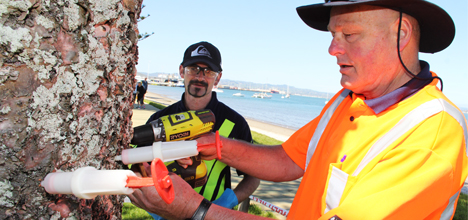
Scientists are confident a simple dose of medicine for 21 of Mount Maunganui's sick Norfolk pine trees is going to save them in the years to come.
Rotorua-based Scion Research scientists are today trialling a course of treatments on the more severely affected trees, believed to be infected by a pathogen, on The Mall and Marine Parade.
Steve Chapman and Kane Fleet work on treating a Norfolk Pine on Pilot Bay. Photos: Daniel Hines
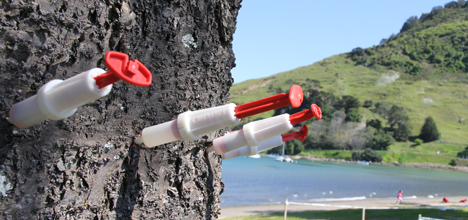
The 50-60-year-old trees suffering a decline in health are being fenced off and injected with medicine in a process that takes about one to two hours per tree.
The procedure, in consultation with Tauranga City Council, is a preliminary trial aimed at diagnosing the cause of the decline and improving the health of the trees.
So far Scion's research indicates a pathogen called Phytopthora multivora is likely responsible.
Scion Research forest pathologist Peter Scott says 14 trees were cordoned off and treated on Thursday.
The trees are being injected with a mixture of phosphite and micronutrients, two applications that are routinely and safely used in agriculture. Phosphite is a biodegradable salt that is widely used to control certain pathogens.
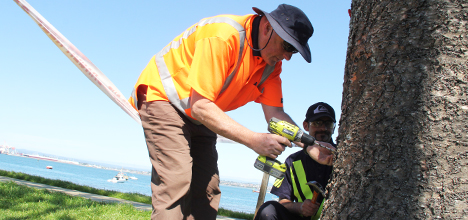
After today, the 21 trees will be closely monitored in the next two years for signs of recovery. If the treatment proves successful, it may be used in further research aimed at improving the health of declining Norfolk pines throughout the country.
'This is a very small trial and we are quite limited really because they are very expensive trees because they are iconic and in a public place; so it is difficult to do a large trial,” says Peter.
'These treatments have been used in New Zealand before on the horticulture plants on avocado farms and have been used in plants worldwide for decades.
Not knowing the exact cause until further monitoring and testing is done, it could quite possibly be down to a combination of factors, says Peter.
'It's very likely the cause of the decline involves many factors. The truth is we know the trees are suffering from drought, we know they are suffering stress and some pathogens are involved as well as insects.
'We are taking a very cautious stance and we want to really know about what is going on before we make a statement.”

0 comments
Leave a Comment
You must be logged in to make a comment.