


A Te Puna earthworks and rubbish removal company is being ordered to pay $16,400 for illegally burning asbestos, treated timber and other contaminants earlier this year.
Contour Limited, and its owner Stephen Mark Miller, appeared for sentencing in Tauranga District Court yesterday for discharging contaminants into the air at the company's Waikaraka Drive East premises in January 2013.
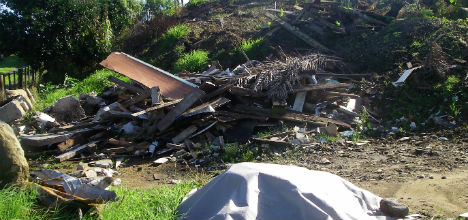
A pile of burnt waste at Contour Limited in Te Puna.
According to the summary of facts, The Relocatable House Company asked Miller to demolish and remove several structures from a Bellevue property, including a workshop, fence and a garage clad with cement board.
Miller then took roofing iron to a recycling company, tyres to a tip and removed three truckloads of demolition waste, which he burned at his own property.
Later in the week Bay of Plenty Regional Council received a complaint that a contractor was disposing asbestos in an unapproved place.
Upon inspection by a council officer, a large pile of demolition waste was located at the property including polystyrene, treated timber, electrical wire, plastic, cement board, laser light sheeting, green waste and tyres.
According to the officer, some of the waste had been buried and some burned. Samples taken at the property were found to contain white asbestos, brown asbestos, arsenic and copper.
Miller told the officer he had not worked with asbestos before and did not know the rules on dumping waste, but knew about special requirements for disposing of asbestos.
Knowing it is illegal burn plastic, electrical wire and treated timber, Miller still burnt the waste without consent.
The court heard how asbestos in cement board is not particularly hazardous, but if it became fragmented the risk increased. While burial is the proper disposal method, some areas of New Zealand have had large quantities buried, which became a problem when land was later converted to residential use.
Proper removal of asbestos cement board includes spraying it with PVA glue and water, breaking it as little as possible, wrapping it in plastic sheeting and removing it in plastic-lined bins and disposing of it at an approved site.
A total of 821 asbestos-related diseases, including lung cancers and asbestosis, were recorded in New Zealand in the last 12 years, according to the Asbestos Diseases Association of NZ's annual report.
Council's pollution prevention manager Nick Zaman says council is concerned about the increasing number of illegal waste disposal cases, particularly those involving asbestos.
'This is a local and national problem. The increasing costs of waste disposal and more stringent earthquake-strengthening requirements means that some demolition and waste disposal contractors are taking the risk of disposing of waste illegally to get their business ahead of their competitors.
'By disposing of asbestos and other hazardous waste unlawfully, contractors are not only putting themselves but the wider community at risk,” says Nick.
'They are also putting future users of affected land at risk. Many reputable demolition contractors in the Bay of Plenty now routinely engage asbestos specialists to confirm whether or not buildings contain asbestos.”
Ninety-per cent of the fine must be paid to the regional council.

0 comments
Leave a Comment
You must be logged in to make a comment.