


An opportunity to make money out of the sea lettuce that chokes Tauranga beaches in summer is to be explored in a joint venture with Chinese, Korean and New Zealand scientists.
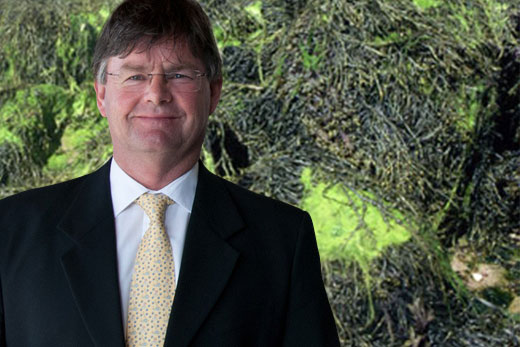
Waikato University professor of coastal marine science Chris Battershill.
Waikato University professor of coastal marine science, Chris Battershill, announced the agreement during the delegates' report to council following the recent sister-cities trip to China, Japan and Korea.
The three-way deal between the Yantai Institute of Coastal Zone Research, Chinese Academy of Sciences; Korean Institute of Ocean Science and Technology; and University of Waikato Coastal Marine Field Station at Sulphur Point will explore ways of turning sea lettuce into biofuels and other commercial products.
There are unique challenges, among them New Zealand law, which blocks commercial seaweed developments.
'Currently the legislation is a little bit mixed about the ability to grow seaweed,” says Chris. 'That's part of the wider scope of work that we need to get involved in in order to influence shifts in one of the concepts.
'If legislation can be moved to make better use of the material, that will have an impact on some of the problems.”
He's talking about seaweed in general, how it can be successfully and sustainably cultured, and how seaweed culture can be mixed with existing aquaculture so the waste from one crop can feed another. It's called integrated multi-trophic aquaculture.
It's also called blue biotech, the application of molecular biological methods to marine organisms in the development of drugs, cosmetics, biofuels and other active ingredients.
How quickly it will happen comes down to money, says Chris.
'If we have a reasonable amount of funding – not multi-millions, but a reasonable amount – we can make some good traction in a couple of years, to the point where we can set up a concept biofuels reactor and have proof of concept. That's assuming a moderate amount of co-investors funds.”
It's the reasoning behind linking with the Chinese, because they have done it before, says Chris. Waikato University is also engaging with colleagues in Queensland.
'With partnerships, we can make traction without reinventing the wheel. We don't want to waste our time on early stages that have already been done. But at the same time, we want to capture the intellectual property and make it of maximum benefit to this region – and the country, of course.”
Once they learn how to make money out of it, the next problem will be organising a sustainable and predictable supply of sea lettuce.
'That's one thing we need to think about, this boom-bust with sea lettuce on the coast. Anything we set up, if it's going to create new jobs it's going to have to be stable. That's going to be the tricky bit.”

0 comments
Leave a Comment
You must be logged in to make a comment.