


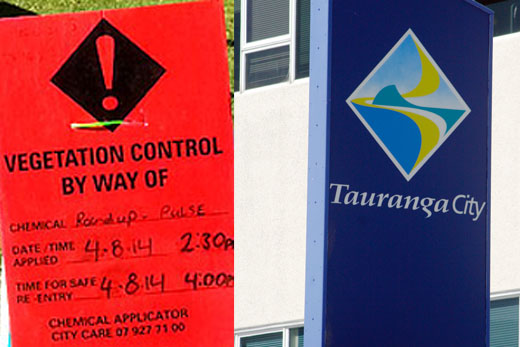
Tauranga City Council will today look at loosening controls over the public use of chemicals in parks and reserves.
The review of the city's toxic agrichemical policy is a result of submissions received on the Coastal Reserves Management Plan last year.
Tauranga City Council will today look at its agrichemical policy.
Today's City Vision Committee meeting is being presented with recommendations to carry on as usual with the use of chemicals, while deciding at the same time that the whole underpinnings of council's poisons' policy be reviewed.
Included in the review is the future role of the Toxic Agrichemical Advisory Forum, a ‘brains trust' of independent advisors that offer advice on the use of chemicals and their likely effects on the ecosystems and people.
In submissions concern was raised over the suspected failure of the policy to meet its primary goal of protecting public health and principles of proactive reduction in use of agrichemicals, prudent avoidance, and preference of non-chemical vegetation control.
The public is also concerned at a lack of scientific literacy among council staff that are making the recommendations to council, but the greatest concern is over the continuing use of glyphosate, or RoundUp.
Council staff recommend a monitoring and reforming framework be developed to guide the implementation of the policy across all council maintained-land.
Staff also want the annual review of the Schedule 1 chemicals be changed because it is 'too restrictive” and a lengthy process to review each year.
Staff say the Toxic Agrichemical Advisory Forum does not provide a balanced advisory group and is not science-based, and that it doesn't have in-house scientific expertise to assess chemicals and so must rely on government regulation and assessment - and that the council has a duty to remove pest species on Council land and maintain Levels of Service and non-chemical methods cost more.
No alternative non-chemical methods have been trialled or evaluated since 2002.

4 comments
Overit
Posted on 12-08-2014 16:27 | By overit
There you go, no alternative non-chemical methods have been trialled since 2002. Just spray your poison about to get ion the waterways onto the harbour etc. Try hot water or slightly more expensive organic sprays that don't harm insects, frogs, birds, animals or humans.
About time!
Posted on 12-08-2014 17:16 | By How about this view!
We have a number of MINORITY groups who claim loudly that they represent "The Community" and know what's best for us all and through their interference "The Community" is carrying an increased cost for general maintenance. I am of the opinion that we should only have large "destination" playgrounds for our kids to enjoy top quality, well maintained equipment and the other parks and reserves that are not sports fields ie. the dogs toilets, should become regeneration areas of native plantings and be maintained by judicious spraying and regular domestic waste removal (Wind blown refuse). Simple, cheap and just about hard enough for the council to manage. Please let's reduce costs for maintaining public areas.
huh
Posted on 12-08-2014 17:19 | By Capt_Kaveman
money spent to go nowhere these are toxic sprays and should be banned what happened to plain old hot salt water?
Not scientific?
Posted on 12-08-2014 20:14 | By Croaky
Strange comment by the council staff that TAAF are not "science based". TAAF was created BECAUSE there are no scientifically-literate members of staff working on the spray program and needed a independent, scientifically-literate team to provide a counterbalance to the non-independent (as in industry-based) "advice" of ERMA. TAAFS recommendations, in particular concerning the toxicity of glyphosate (Roundup) have been repeatedly ignored by council staff who quote industry-funded "advice" - not good, independent science - that say these chemicals are safe. Council staff then say they have no-one else other than ERMA to go to for independent advice, despite that fact that TAAF was specifically created for this purpose. What is particularly galling is that good, low-toxic or non-toxic methods of weed control are available, but they require the staff to wake up and change their mindset, which they seem unable to do - and wildlife and human health suffer.
Leave a Comment
You must be logged in to make a comment.