


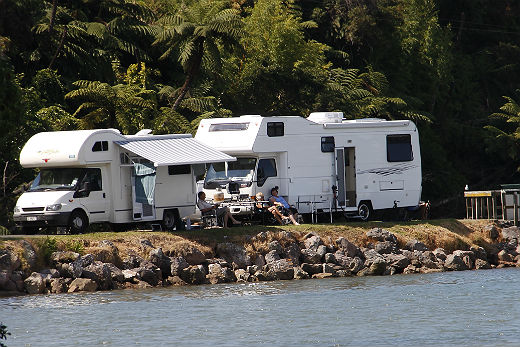
A High Court judgement has quashed some of Thames-Coromandel District Council's freedom camping rules after they were challenged by The New Zealand Motor Caravan Association.
The NZMCA took the council to court over its multiple bylaws relating to freedom camping, saying they seriously restricted where members could freedom camp in the district.
Some of Thames-Coromandel District Council's freedom camping rules have been quashed in a High Court hearing this week.
In the High Court in Hamilton on Monday, Judge Cooper ruled two clauses – prohibiting people to camp, or park a vehicle to camp, in any place unless at a licensed camping ground, dedicated freedom camping location or with written council consent – to be revoked.
The Judge also ruled amendments the council made to its Freedom Camping Bylaw on March 13 and November 27, 2013, were unlawful, saying: 'The amendments are severed from the Freedom Camping Bylaw and quashed”.
According to the court rulling, the NZMCA took the council to court to challenge the validity of it's Freedom Camping Bylaw 2011, created under powers given to local authorities by section 11 of the Freedom Camping Act 2011.
Namely the NZMCA challenged the validity of amendments the council made to the Freedom Camping Bylaw in 2013.
It is alleged the council acted unlawfully by not using the special consultative procedure set out in section 83 of the Local Government Act 2002 in making the amendments.
Judge Cooper upheld this complaint. 'This means that the Bylaw that needs to be assessed for the purposes of the Association's arguments about substantive invalidity is the Bylaw in the form it took when it was made by the Council on 14 December 2011,” said Judge Cooper.
The NZMCA also mounted challenges to clauses of the council's Public Places Bylaw 2004 and Parking Control Bylaw 2004, which were also said to be illegal and invalid.
The council had made a new Consolidated Bylaw in 2004, containing sections on ‘Activities in Public Places' and ‘Parking Control' rules, which became operative from September 8, 2004.
The bylaws were made under the TCDC's bylaw-making powers under the Local Government Act 2002.
The Public Places Bylaw was adopted on July 6, 2011, with a new clause 203.5 stating a person must not camp in any place unless at a licensed camping ground, dedicated freedom camping location or have written consent from a community board chair and council chief executive.
Following TCDC resolving to proceed with the special consultative procedure in respect of the proposed new Parking Bylaw provision June 2009, and having considered submissions subsequently received, it agreed to include what eventually became clause 2003.5 in the Parking Bylaw.
Clause 2003.5 provides: 'Without the prior consent of the council no person shall stop, stand or park any vehicle on any road or in any public place for the purposes of camping, with the exception of those areas identified as approved camping areas”.
This bylaw was also attacked by the NZMCA on the same grounds of invalidity.
The NZMCA also claimed these three bylaws prohibit freedom camping in all public places in the council's district, with certain exceptions.
It is also said cumulatively, the provisions of all three bylaws constitute an unlawful restriction on the ability to engage in the activity of freedom camping.
Judge Cooper ruled the council take the necessary statutory steps pursuant to section 156 of the Local Government Act 2002 to revoke clauses 203.5 and 2003.5 of its Consolidated Bylaw.
'The Council should diligently proceed with and complete the steps…Pending completion of the steps required by paragraph (a) I direct that the Council is not to enforce Clauses 203.5 and 2003.5 of its Consolidated Bylaw.”
'I declare that the amendments made to the Freedom Camping Bylaw on 13 March and 27 November 2013 were unlawful. The amendments are severed from the Freedom Camping Bylaw and quashed.”
Judge Cooper said the intent of the orders is that, for the future, freedom camping in the council's district be governed only by the terms of the Freedom Camping Bylaw, as may be validly amended from time to time.
'This judgment is not intended to hold and does not hold that the council could lawfully maintain in force the Freedom Camping Bylaw and Clauses 203.5 and 2003.5 of the Consolidated Bylaw.
'In the event that the council for whatever reason does not complete the processes required by [138](a) and (b), I expressly reserve leave to the Association to apply again for orders challenging the validity of Clauses 203.5 and 2003.5 of the Consolidated Bylaw. Such application if made may be dealt with by another High Court Judge.
'The Association's claim is otherwise dismissed, subject to the reservation in [139].”

0 comments
Leave a Comment
You must be logged in to make a comment.