


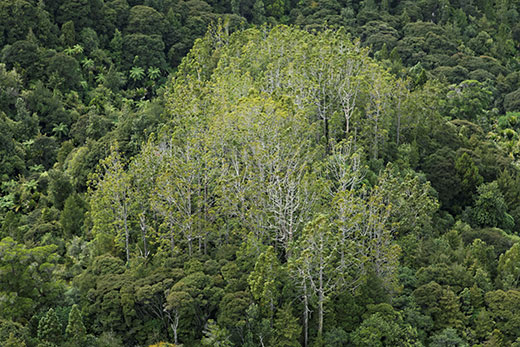
Waikato Regional Council will be working with a private landowner to prevent the spread of kauri dieback from infected trees on their Coromandel property.
The new discovery has been confirmed following aerial and ground surveillance carried out across the Coromandel Peninsula and the northern Kaimai Ranges to determine the spread of the disease.
Council says there's no connection between the new site identified with kauri dieback and this initial site (pictured)in the Whangapoua Forest/Hukarahi Conservation Area Trees near Whitianga.
Waikato Regional Council biosecurity officer Jeanie Allport says the new find of kauri dieback is a concern, but there is no connection between the new site and the initial site in the Whangapoua Forest/Hukarahi Conservation Area.
'The infections were confirmed through soil sampling involving our staff and the Department of Conservation, after aerial surveillance was undertaken following confirmation of the discovery at Hukarahi earlier this year,” says Jeanie.
'The new site is some distance from the Hukarahi site, and there's absolutely nothing to suggest kauri dieback was spread from one site to the other.
'In fact, the thinking is that the disease has probably been there for a long time – perhaps decades and possibly during the establishment of the commercial pine forest at Whangapoua.
Jeanie says steps have already been taken to ensure people avoid contact with the affected area – and if they do go through it they clean any clothing, boots and equipment that come into contact with soil.
'Moving forward, we'll be supporting the landowner to help them put in place a site-specific plan to manage the risk of the disease spreading from the site over the long term,” says Jeanie.
On behalf of the Kauri Dieback Programme, the regional council is also in the process of checking three other suspect sites.
'In areas where trees appear symptomatic it's necessary for us to analyse soil samples because not all ailing kauri are infected with kauri dieback. We need to get confirmation that the disease is present rather than just assume that to be the case.”
Kauri dieback is caused by a microscopic fungus-like organism called Phythophthora taxon Agathis, which is spread through microscopic spores in soil and water.
This disease infects kauri roots and damages the tissues that carry nutrients and water within the tree. This basically starves the tree to death.
Symptoms include yellowing leaves, canopy thinning, dead branches and bleeding gum at the base of the trunk. Nearly all infected trees die.
More information on kauri dieback is available here.
Jeanie says under the Waikato Regional Pest Management Plan it's the regional council's responsibility to work with landowners when kauri dieback is identified on a private property.
She says the council wants to keep a lid on the spread of the disease, in cooperation with its partners in the multi-agency Kauri Dieback Programme.
'The public can assist with this kaupapa by taking care in all areas where kauri are present,” says Jeanie.
'Anyone who visits or works in an area containing kauri should make sure they clean every trace of soil from their gear, and disinfect it, before and after their visit.”
Meanwhile, the Kauri 2000 Trust has set up a new Coromandel Kauri Dieback Forum.
The group, which is meeting for the first time last month, will look at the practical things people can do to protect kauri in their communities.
Anyone interested in joining the group should contact Kauri 2000 on 07 866 0468 or email info@kauri2000.co.nz.

0 comments
Leave a Comment
You must be logged in to make a comment.