


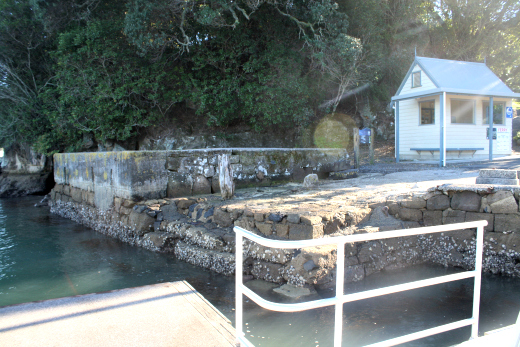
Thanks to a grant from Lotteries Environment and Heritage Fund plus council funding, restoration work will begin on the Whitianga Historic Ferry Landing Wharf this year.
Built in 1840, the wharf is believed to be the oldest working stone wharf in the Southern Hemisphere and is classified as a Grade One structure by the Historic Places Trust.
Restoration work will take place this year on the Whitianga Historic Ferry Landing Wharf thanks to a combination of external and Thames-Coromandel District Council funding. Photo: TCDC
But for many years it has been in a state of disrepair, with some of the original stone blocks lying on the sea floor beside the wharf and sections of the stone steps and wall missing.
The Thames-Coromandel District Council, in partnership with the Historic Places Trust, iwi, Institute of Engineers and Mercury Bay community, have worked towards restoring the wharf.
Mercury Bay Community Board Chairperson Paul Kelly says council staff applied to the Lotteries Environment and Heritage Fund in 2014.
'We found out very late last year that we'd been granted $187,645 towards the project,” says Paul. 'On the success of this external funding, council will now contribute $279,438 towards the project.
'The cost to do the entire work - from the restoration of the stonework through to installing interpretative historical signage and landscaping - is estimated at $715,000.
Paul adds: 'As there is still a shortfall of $250,000, we are dividing the project into three phases and we will continue to apply to external agencies to complete the work.”
Phase one starts this year and will focus on restoration and protection of the eroded stonework, including the recovery of some of the old stones from the sea.
Phase two will be the upgrade of the ferry landing footpaths and entrance area, while phase three will be the installation of historic and cultural panels and signage.
Mercury Bay acting area manager Len Whittaker says the wharf is unique to the area, as well as having local, national and international significance.
'It's been documented that local Maori were engaged to construct the original structure,” says Len. 'It's also been identified as an archaeological site in the NZ Archaeological Association site file.
'Throughout those times until present day it's been used by ferries and boating vessels and is a key passenger transport and recreation hub for both locals and visitors.”

0 comments
Leave a Comment
You must be logged in to make a comment.