


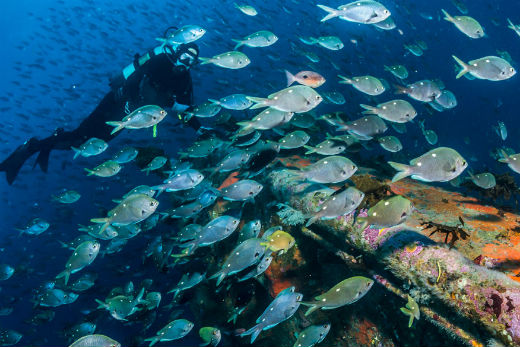
A marine biologist is calling for Astrolabe Reef's exclusion zone to remain in place to act as protection for the reef's recovering marine life.
Dr Roger Grace's evidence was originally due to be delivered as part of the Motiti Rohe Moana Trust's findings – that was until they reached agreement with owners and insurers and withdrew from the resource consent hearing.
Dr Roger Grace wants Astrolabe Reef's exclusion zone to remain. Photo: File.
His evidence was then delivered as personal submission, claiming that many witnesses at the hearings have commented on the recovery of marine life since nobody has fished the reef since the ship ran aground in October 2011.
Dr Grace is calling for a continuation of that protection and seeking long term protection through a marine reserve, type 1 MPA, or a rahui tapu.
'There have been two major ‘good' things to have come out of the Rena disaster,” says Roger.
'The first is how the community came together to deal with a major environmental problem in the Bay, and the second is the beginnings of a recovery of fish life and ecology at Otaiti because of the no-fishing effects of the exclusion zone.
'It would be a pity to open up the reef to fishing again and lose the benefits of an area heading towards recovery from many years of fishing.”
Protection from fishing during the four years of the exclusion zone has allowed life on the reef to begin the long process of recovery from 100 years of intensive fishing activity, says Roger.
Earlier evidence commented on the increase and abundance of fish on the Reef over the past four years, which is considered a consequence of the cessation of fishing for seafood species within the exclusion zone around Otaiti.
In the joint witness statement on ecology, experts agreed that from an ecological recovery perspective, a 'no-take” fishing protection area over the whole reef would remove one of the multiple stressors, says Roger.
'Fish life in the Bay of Plenty is a mere shadow of what it was early last century. In fact I have heard the term Bay of Empty used to more accurately describe the Bay in recent years.”
The Ministry of Primary Industry shows the 2013 biomass of snapper in the region was only 13 per cent of the pre-fished biomass.
A Kaimoana Resource (hapuku) of significance to iwi has almost certainly been lost as a consequence of unsustainable levels of fishing being allowed over the past century or more.
Fishing alone is blamed for a decline in hapuku abundance and the almost total loss of hapuku from shallow coastal reef habitats throughout the Bay of Plenty.
'Much has been made of the desire to restore taonga species such as snapper, crayfish and hapuku to the reef,” says Roger. 'That is simply not going to happen in the presence of fishing.
'Some form of sanctuary status around Otaiti, to allow fish life to again flourish in spectacular fashion, would be a fitting tribute to the sad loss of marine life, seabirds and mauri as a result of the damage caused by the wreck.”

3 comments
Over-fishing
Posted on 02-10-2015 20:58 | By firstperson
Totally agree. Glad you have highlighted the point. Hopefully someone will take notice instead of focussing on slinging potshots at each other. A marine protected area is called for.
Why not
Posted on 03-10-2015 11:05 | By How about this view!
Sink MORE wrecks along out coastline to keep the commercial fishing operations where they should be and to create more structure for recreational fishing activities?
How about Rabbit Island
Posted on 04-10-2015 04:18 | By Johnney
Why not include Rabbit Island as well as this would make it safe for the more inexperienced and novice diver. We could create another Goat Island like at Leigh just north of Auckland. Also would create a great nursery for all the minnows to replenish our fish stocks.
Leave a Comment
You must be logged in to make a comment.