


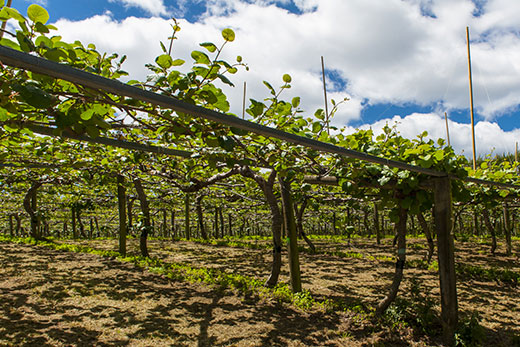
Gold kiwifruit orchards in the Bay are selling for as much as $550,000 per hectare, and green for $400,000, even though harvest is still four months away.
That's the message from Stan Robb of PGG Wrightson Real Estate in Te Puke.
Some orchards have sold within 24 hours of being listed. Photo: File.
Despite high prices and strong demand, Stan says there is a huge shortage of orchards for sale and those which are listed are snapped up quickly – sometimes within 24 hours.
'In my 28 years of selling, I've never seen anything like the current demand,” says Stan.
'Many properties are going to tender and achieving higher prices than agents and valuers have put on them. It's pretty exciting for the venders, but not so exciting for the purchasers.”
Many purchasers are existing orchardists looking to expand, while some are investors. Sharemilkers leaving the dairy industry are also among buyers.
'There is interest from overseas buyers,” confirms Stan, 'but because Overseas Investment Office approval is required to buy rural land over four hectares, few venders are willing to wait when there are other purchasers in a position to buy now.”
Just five years ago, when the kiwifruit industry was hit by the vine disease Psa, Stan says he would never have predicted the industry would recover so quickly or that orchard prices would reach their current high.
'In reality, I can't see prices going much higher than they are now because there is still a risk factor with growing kiwifruit, as there is with any horticultural crop,” he says.
The return of confidence in the industry is having a positive impact on Te Puke and other rural communities. 'When Psa hit, people were leaving Te Puke in their droves to find work elsewhere.
'Now I understand house prices in Te Puke are rising and people are returning.”
In the past two weeks, Stan and his son Chris have sold seven orchards, one for $3.5 million and a smaller one for $1.4 million.
'Buyers are seeking top quality orchards in good growing locations, and for the first time Bay of Plenty orchardists are even willing to look to other regions, including Hawkes Bay, to buy orchards.”
At the end of October the sale of a 9.81 hectare premium Te Puke property, comprising a mix of vines, broke a number of records, says Stan.
One of New Zealand's finest kiwifruit orchards, facing north at 80 metres above sea level on free draining soils with an outstanding production history of bumper crops of large fruit, it included sections of mature green kiwifruit and some gold, plus land with development potential.
Calculated at per canopy hectare values, the successful tender for this property equated to $400,000 for the green kiwifruit, $450,000 for the non-producing gold, and $550,000 for the mature gold sections, which were record values for all three.
A trio of unsuccessful tenders for this property were all similarly pitched.
A further two orchards sold in mid-November, illustrating the market's current enthusiasm. Situated in Thornton, which is more frost prone than Te Puke and produces less, these two smaller orchards were only briefly on the market.
'Both producing gold kiwifruit and both in the same ownership, they were offered for sale on a Saturday evening, received offers on Sunday, and had sold unconditionally, each for around $470,000 per canopy hectare, by Friday.”
Stan says until a few months ago, prices were well short of this level, even for highly coveted properties. Now, effectively second-tier orchards are also caught up in the fervour.
'How many more sales of this type will occur over the coming months remains to be seen,” he says.
'With another bumper crop indicated this summer, most orchardists will be content to enjoy the coming few seasons' prospects, rather than cashing in on the current record property values, so new listings are likely to be scarce.
'However, there may be a few exceptions. While they are largely independent of each other, and experiencing contrasting fortunes, the dairy and horticulture sectors do have some owners in common, when dairy farmers have diversified into orchard ownership, and vice versa.
'My PGG Wrightson Real Estate colleagues elsewhere in the country who specialise in marketing dairy property have observed fewer sales recently, due to divergent opinions between buyers and sellers on a dairy property's current worth.
'While potential buyers are budgeting based on Fonterra's payout forecast for this season, vendors are holding on to what land was worth when the payout was $8. As and when buyers' and vendors' expectations come together again, some foresee dairy farm prices softening.
'If so, those dairy farmers who also have equity in kiwifruit may shift the latter into what will have become relatively favourably priced dairy property.”

0 comments
Leave a Comment
You must be logged in to make a comment.