


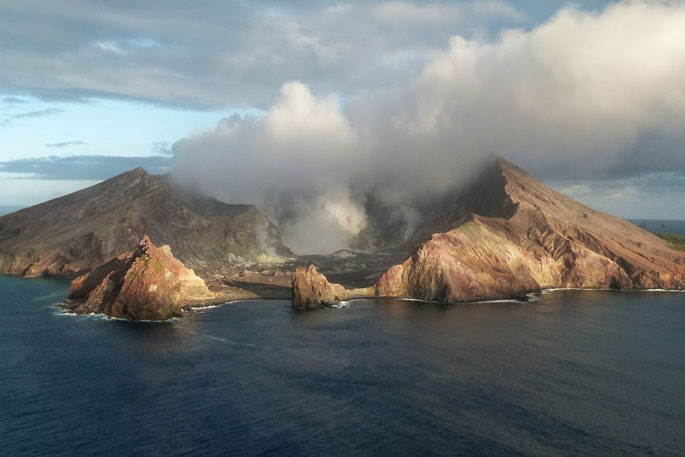
GNS Scientists monitoring the gradual increase in volcanic activity at Whakaari/White Island have raised the Volcanic Alert Level to Level 3 while the Aviation Colour Code remains at Orange.
Over the past few months, volcanic ash has been identified more frequently in the Whakaari/White Island steam and gas plume.
Evidence of intermittent explosive activity has also been observed during recent observation and gas flights.
Duty Volcanologist Geoff Kilgour said despite limited direct observations of activity over the last few weeks, images from the webcams at Whakatāne and Te Kaha continue to record an increase in volcanic ash in the steam and gas plume at Whakaari/White Island.
"Over the same period, our colleagues at MetService have been able to detect minor amounts of volcanic ash in the plume using satellite imagery," KIlgour said.
"From the coast, this can be seen as a hazy plume trailing downwind from the volcano."
Kilgour said these observations indicate that there has been a gradual increase in eruptive activity and in response, the Volcanic Alert Level is now raised to Level 3.
Recent gas and observation flights, and satellite data have confirmed that there has been a gradual increase in the amount of volcanic ash in the plume from Whakaari/White Island.
Kilgour said volcanic ash emissions remain minor and during periods of northerly winds, the plume of gas and ash may be noticed by residents on the coast as sulphur odours.
"We do not expect ash fall to affect the Bay of Plenty coastline at this time," Kilgour said.
"During recent observation flights, we have observed impact craters on the main crater floor, indicating that on occasions, more explosive activity has occurred, ejecting rocks several hundreds of metres away from the vent."
The vulcanologist said explosive events like these are common at Whakaari as active vents grow, periodically become clogged, or gas flux increases.
"Monitoring data from our gas flights, thermal InfraRed temperature measurements and the sulphur dioxide (SO₂) emissions detected by satellite, all show slight increases, which is consistent with an overall increase in volcanic activity, and more frequent ash emissions."
Kilgour said steam, gas, and volcanic ash emissions remain variable as they have been for the past few months.
"And due to our lack of on-island monitoring, it is possible that short-duration eruptions are occurring without being directly recorded."
He said recent activity is consistent with a low level of eruptive activity and therefore, the Volcanic Alert Level is raised to Level 3.
"The continued presence of volcanic ash emissions mean that the Aviation Colour Code remains Orange. These levels acknowledge the gradually increased volcanic activity but also reflect the increased level of uncertainty."
GNS Science’s Volcano Monitoring Group and National Geohazards Monitoring Centre will continue to closely monitor Whakaari/White Island for any changes in activity.
"Without sensors on the Island, our monitoring continues to rely on remote cameras, satellite imagery, and periodic observation and gas flights to monitor Whakaari.
"We will provide further updates when information becomes available."
Further information about the Volcanic Alert Levels and what they mean can be found here.
For information about the impacts of the steam and gas plume should it reach the coast, follow the advice from:
Bay of Plenty Emergency Management
NEMA: What to do during volcanic activity
Toi Te Ora Public Health: Volcanic Activity

0 comments
Leave a Comment
You must be logged in to make a comment.