


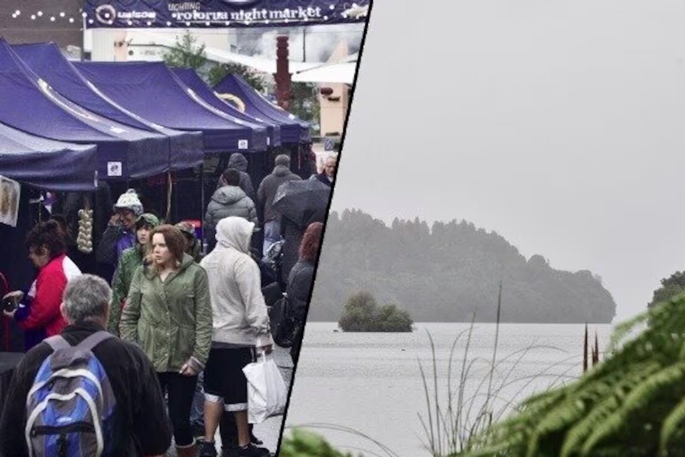
Rotorua councillors are considering hours of feedback and hundreds of submissions on its draft annual plan.
A range of opinions were shared at the council’s draft Annual Plan 2025/2026 hearings last week.
Some related to the Tarawera sewerage scheme, others the city’s night market. Other submissions asked for funding increases with one trust detailing its success story.
During the hearings Rotorua Trails Trustee Clair Scott outlined a “good news story”.
The trust submitted that while the council investment of $217,000 a year was “instrumental”, it urged a “significant increase in funding” in this annual plan to continue trail network maintenance and development.
It said this was vital to sustaining and enhancing the millions of dollars of economic contributions from mountain biking and trail running.
Scott said investment “paid off in a big way” with 300km of trails being one of the city’s most valuable recreational and economic assets. It supported major events, helped grow local mountain biking talent, brought in visitors, and boosted health and wellbeing while telling a “broader story of what makes Rotorua special”.
The council funding covered about 25% of its operational costs.
Scott said the team was stretched as donations and grants became harder to secure; it faced a $140,000 funding shortfall this year.
She said she wasn’t there because something was broken, but because it was thriving.
The trust wanted the council to partner in developing a sustainable long-term funding model.
 Rotorua Trails Trust is asking for more council funding to sustain and grow its network. Photo / Joel McDowell
“This is a good news story. A Rotorua success we should all be proud of.
“To keep it going we need to start treating these trails as the essential infrastructure they have become.”
Councillor Robert Lee asked whether a user charge could be applied to the trails, to which Scott said no as it was iwi-owned land with a Crown agreement to allow public access until 2042.
Many submissions related to whether the $32.3 million Tarawera Sewerage Scheme should have wider ratepayer funding, including input from community figures and residents arguing whether the scheme was justified and fair and that the cost burden on them was too high.
Lake Ōkāreka Community Association chairman Mitch Collins said the council failed in its planning.
He referred to district plan rules relating to recent court action debate on what was permitted earthworks activity.
Collins understood the plan required review every five years for efficiency and effectiveness but he said aspects of it had not been reviewed for two decades.
Cost added could have been avoided with better planning, he said.
Collins said the board acknowledged the need for the scheme to protect lakes, but it was concerned about the cost increases. It supported a further $4m of funding via the wider ratepayer base.
His community’s scheme cost about $20,000 per household “in today’s terms”. The Tarawera scheme as it is funded now would cost about $50,300.
Ōkāreka residents had seen lake health improvement since their scheme was completed in 2011, he said.
 Councillor Kevin Winters at a 2023 Bay of Plenty Regional Council meeting. Photo / Alex Cairns
Former Rotorua mayor and current Bay of Plenty regional councillor Kevin Winters said the council supported the additional $4m for the Tarawera scheme and remained committed to its own $750,000 grant.
An extraordinary meeting is scheduled for May 26 to discuss a district council request for further funding.
Other submitters wanted the scheme to be user-pays with no further funding, while others thought the extra $1m was fair.
Other annual plan submissions included suggestions on how the Rotorua Night Market should be delivered.
For the past year Farnoud Rahimi Mansour had run a stall at the market.
Previously a structural engineer on a sponsored working visa, he said he became an Uber driver when the Government project he was working on was cut.
“Many people lost their jobs.”
The 13 hours driving a day only covered his rent, he said.
“My life depends on the market. That is why I am here.”
He told councillors he was concerned he would end up homeless if there were changes to the night market.
He believed the stallholder fee of $172 each “easily” covered the $200,000 it cost for the council to run the markets.
Mansour’s view was that fee would go up if the market were run by someone else.
He asked the council to consider investing in the market.
Options were to scale it back to half a year, change the location, or have someone else run it with council sponsorship.
Other submitters supported half-yearly as being practical while some supported it being managed by someone else.
Rotorua Lakes Council proposed a 7.95% general average rates rise for the year, down from the projected 9.8%.
It had a capital works programme of $145m, $41.25m funded by debt.
Councillors will deliberate on May 28 and will adopt the plan on June 25.
LDR is local body journalism co-funded by RNZ and NZ On Air.


2 comments
The Master
Posted on 20-05-2025 12:28 | By Ian Stevenson
The theme all over NZ including Government is VERY simple...
1 Stop spending, and
2 Stop wasteful spending (which is always an issue with Bura-rats)
3 Get back to the basics, get them right and up to date - this is what Councils for example don't do, instead indulging in all manner of "Nice to haves".
The Master
Posted on 20-05-2025 12:45 | By Ian Stevenson
The very simple plan of Bura-rats is easy to see...
1 Spend like there is no tomorrow (reckless)
2 Don't give e hoot about the consequence because they just know they are right... always
3 Bura-rats can not understand the public/real world issues hence they live in a world "fluffy ducks" 24/7
4 EM's don't understand their job, Council staff decide on all the spending, EM's job is to go find the money to pay for it.
5 If EM's misbehave (don't go get the required money from ratepayers) then Council staff just borrow whatever so the spending continues...
Did I miss something?
Leave a Comment
You must be logged in to make a comment.