


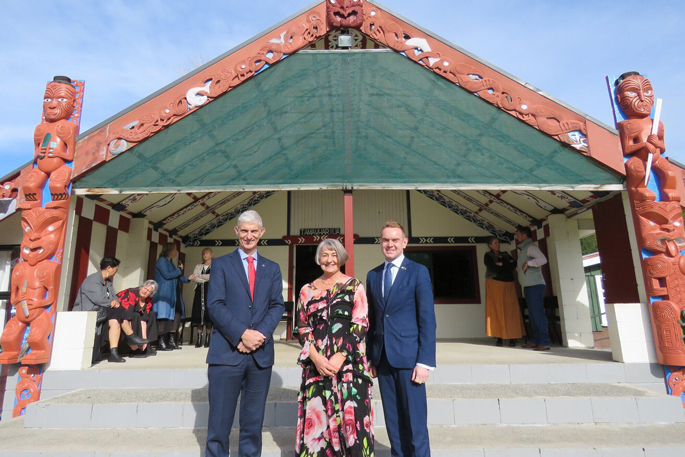
The determining of a special relationship unfolded on June 19 when local hapu Ngāi Tamawhariua welcomed two diplomats, representing Ireland and Britain, on to Te Rereatukahia Marae.
Paul O’Hara, deputy head of mission at the Embassy of Ireland and John Pearson, deputy high commissioner of the British High Commission, stepped onto the marae beside Katikati community leaders for an invite-only powhiri to launch a series of local commemorations to acknowledge the 150th anniversary of the Ulster settlers’ arrival in town this September.
However, the meeting also brought to light the kōrero tuku iho – history – from the tangata whenua into the wider community. On September 16, 1875, the first Ulster Irish settlers arrived in the area which is now known as Katikati, and formed a relationship with local Māori from the beginning.
What brings us together
Te Rereatukāhia Marae chairman Hone Winder-Murray said before the event that “building connections, and celebrating our differences is what brings us together” – and Matariki was an apt time to do this.
“When drawing parallels between te ao Māori and the Northern Irish, it’s vital that we look to our past. While understanding the premise that we are talking about two different peoples – separated by vast expanses of land and ocean, with an entire hemisphere to boot – would an ever-so-distant constellation of stars in the depths of the night sky have any kind of significance for recognising those connections? I believe that the parallels are incredibly worthy of nothing.”
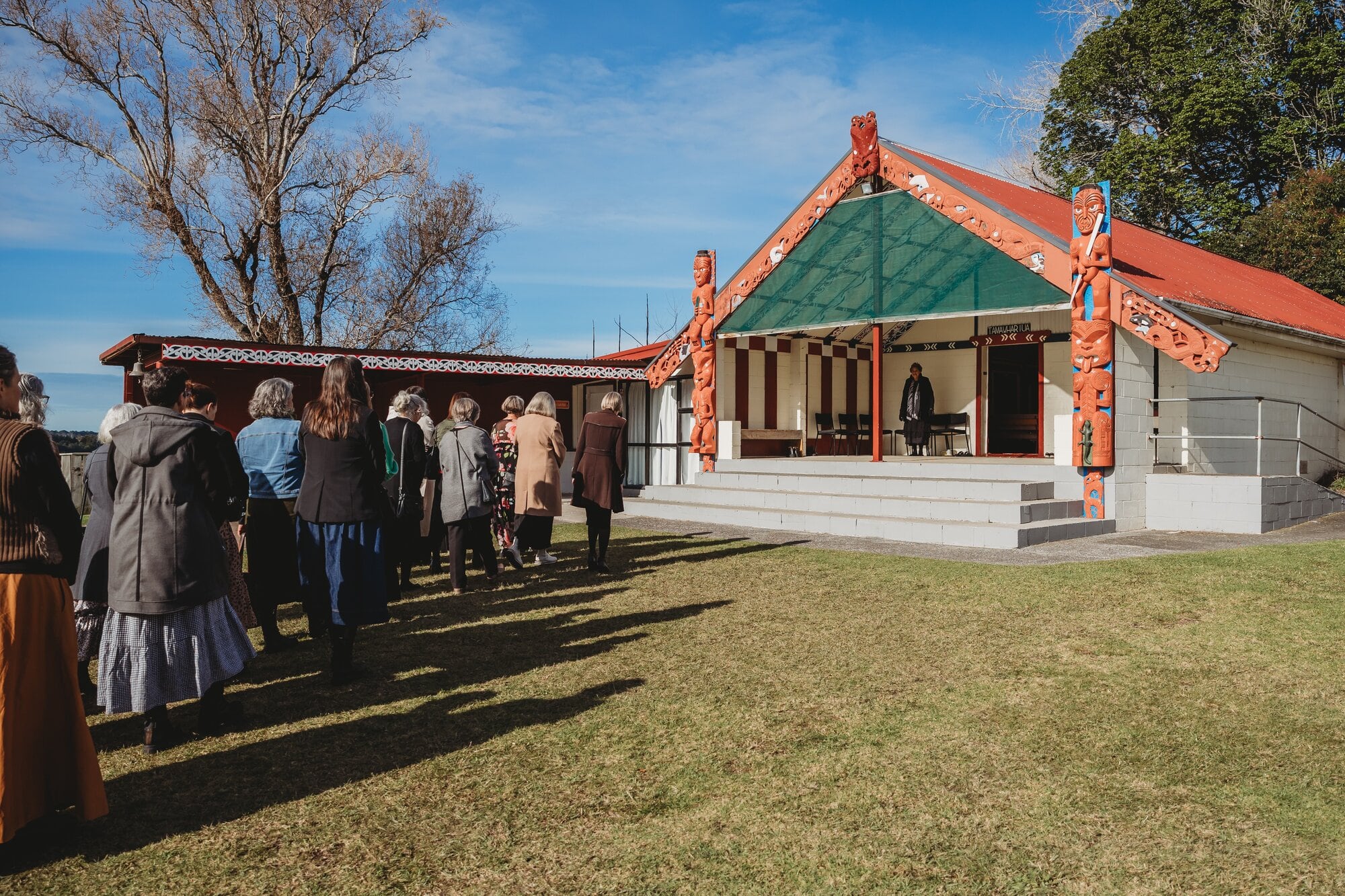
Katikati community leaders get welcomes onto Te Rereatukahia Marae on June 19. Photo / Anna Menendez
Winder-Murray said it was fascinating to explore the local footprint of life in 1875 “particularly when Matariki rose over Papakura, the central area of land which makes up the township now referred to as Katikati, and knowing that many miles away – at the very same time – the Northern Ireland people of Ulster were boarding their respective vessels, bound for the resource-rich and bountiful lands, landing on these shores some 90-odd days later”.
“As we look to the present day, we honour the attendance of the Irish deputy ambassador, and the representative from the British High Commission as they attend our Matariki events.”
O’Hara, Pearson and Katikati community leaders, including Western Bay of Plenty Mayor James Denyer and district councillors, were given a traditional welcome inside the wharenui (meeting house) – with karakia (prayer), speeches and waiata (song).
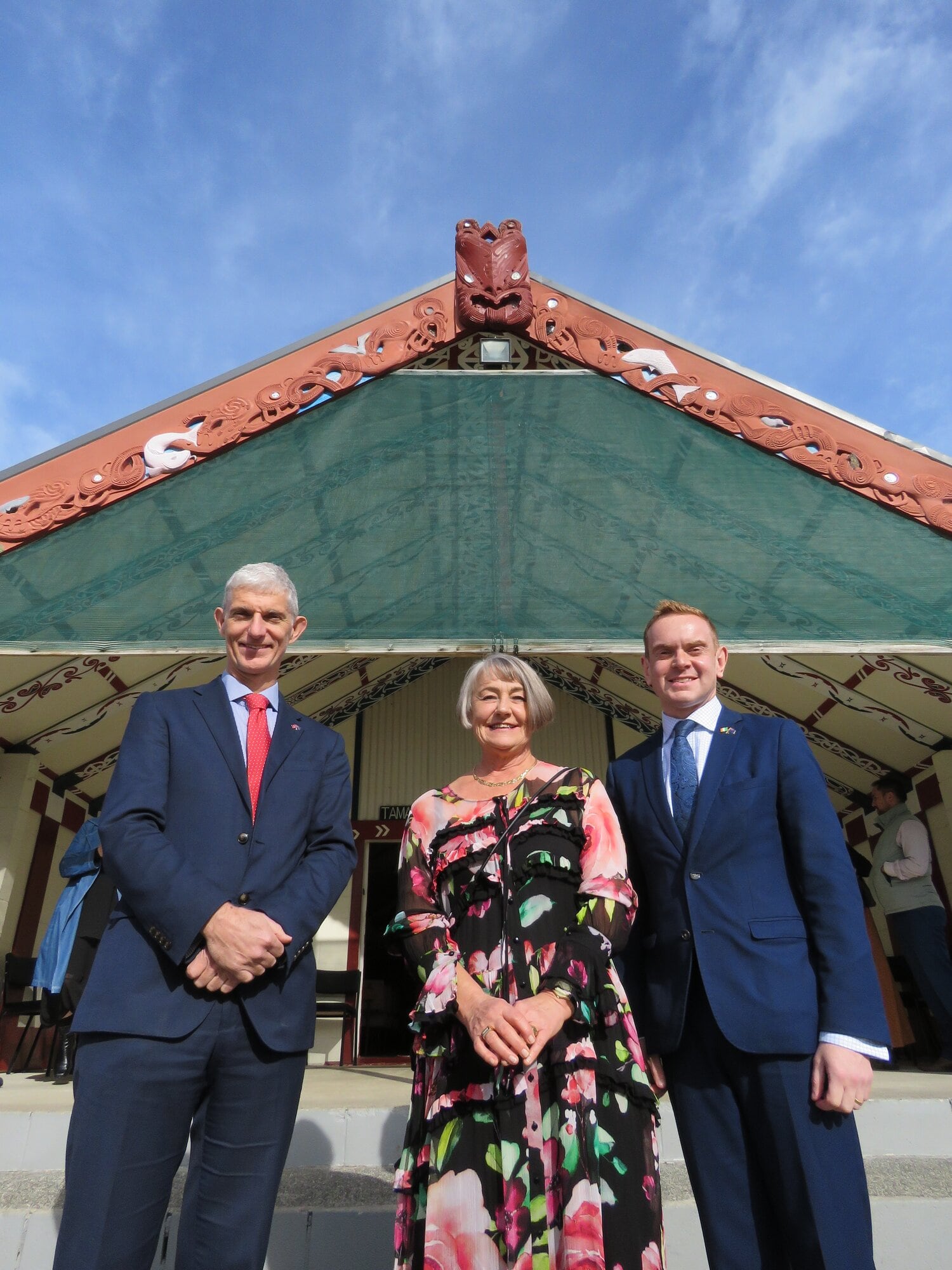
British High Commission deputy high commissioner John Pearson, Western Bay Museum manager Paula Gaelic and Embassy of Ireland’s deputy head of mission Paul O’Hara outside Te Rereatukahia Marae. Photo / Merle Cave
In his speech, O’Hara said he was deeply honoured to be present, representing the Irish, to honour this kaupapa and reflect upon the story of the Ulster settlement of Katikati.
Not an easy legacy
“We gather here on land that holds many stories. The soil of Katikati bears the footprints not just of Ngāi Te Rangi, but the footprints of missionaries and of migrants, including those from Ulster, the northern part of Ireland, who arrived here in 1875.
“I’m here with you as a representative of Ireland in Aotearoa New Zealand, but also as a student of our shared and complex histories”.
O’Hara said both people’s histories involved stories of influence, migration, colonisation and hope. “Among the Ulster settlers who arrived in this region were people who’d left a land of great beauty, so similar in many ways to the landscapes of Aotearoa, but a place that had known great hardship.
“Many would have seen the effects of a devastating famine within living memory, in a part of a country divided by religion and national identity.”
The settlers also brought with them their memories, customs, traditions, and a longing for new beginnings, O’Hara said.
“Some may have been escaping economic hardship and perhaps dispossession, only to arrive in a land where others, tangata whenua, were themselves experiencing a great dispossession. This is not an easy legacy to reckon with.
“But I believe it is our shared responsibility – as manuhiri, as diplomats, and as descendants – to reflect honestly and humbly on all aspects of that history.
“Let us honour the stories of this place, of Māori and Pākehā, Protestant and Catholic, tauiwi and tangata whenua, voices that speak across the generations. Let us honour the artefacts and archives preserved in the Western Bay Museum, not merely as tokens of the past, but as mirrors to our present and guides to our future.”
O’Hara said one of Ireland’s best-known seanfhocail, or whakatauki (proverbs), was “Ní neart go cur le Chéile” which meant “There is no strength without unity”.
Futures interwoven
“These words remind us that our futures are interwoven, just as our past has been. In marking this 150th anniversary this year, let us make space for history that takes account of all aspects of this story, and for connection through commemoration.”
Pearson expressed his thanks for the British High Commission being asked to be part of Katikati’s Matariki events. The Ulster Irish settlers came from Ireland 46 years before the island was partitioned into an independent state, now known simply as Ireland, while six of the nine counties of Ulster became Northern Ireland, which remained part of the UK – hence why Pearson was honoured to be present. “[Northern Ireland is the] Smallest nation in the UK, but one of the richest…so to be at an event like this is really wonderful.”
After formalities, visitors shared food at the wharekai (dining hall), while four people of Katikati talked to their links to the town and the hapū. This included resident Val Baker, archaeologist Brigid Gallagher, Katikati College principal Louise Buckley, and Western Bay Museum manager Paula Gaelic.
Winder-Murray said for Ngāi Tamawhariua, the opportunities to work collaboratively and share their kōrero – through kaupapa like Matariki – had benefited them immensely. “When we look to the future, when we envision the world that we, in each of our communities, aim to build for our children, and our mokopuna, it’s celebrations like this that help bring those aspirations to life.”

0 comments
Leave a Comment
You must be logged in to make a comment.