


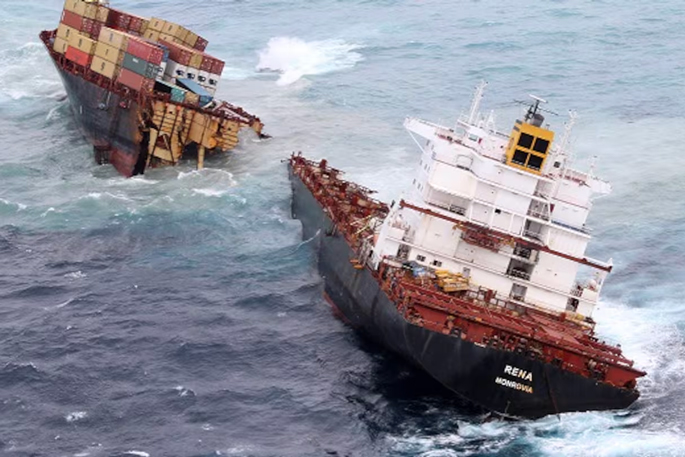
Tauranga’s harbourmaster has taken swift action after learning large ships were using a risky shortcut in the area where the Rena grounding caused New Zealand’s worst maritime environmental disaster.
News the gap between Mōtītī Island and Ōtaiti Astrolabe Reef – which container ship Rena hit in 2011 – was being used to enter Tauranga Harbour left some locals “mortified” and “shocked”.
Bay of Plenty Regional Harbourmaster Jon Jon Peters has issued a formal direction banning vessels above 500 gross tonnes from an area that includes the passage.
The new circular exclusion zone has a radius of 2 nautical miles centred on a point in the north of Mōtītī Island.
The area remained open to smaller vessels, Peters said.
“Manoeuvrability of large vessels is constrained due to their size, momentum and draft and they are therefore at risk of collision or potentially running aground should they transit through this area,” Peters said.
His move followed consultation with Maritime New Zealand and aligned with long-standing recommendations in the New Zealand Nautical Almanac, which advised avoiding the reef-island gap for safety reasons.
Bay of Plenty Regional councillor Stuart Crosby said Peters briefed councillors on May 8 about his intent to extend the existing exclusion zone around the reef, citing concerns over recent ship movements.
“To say that the elected members were mortified that the practice was occurring after the Rena container ship grounding was an understatement.”
Crosby said while the harbourmaster was engaging with Maritime New Zealand to get that extension, Peters also indicated he wanted to use his independent authority to “immediately” implement the restriction, “which we fully supported him doing”.
“He took immediate action and on the 9th of May the restriction was put in place.”
 The Rena container ship after grounding on Astrolabe Reef in 2011. Photo / APN
Crosby was Tauranga’s mayor in 2011, when the Rena container ship struck Astrolabe Reef, causing a massive oil spill. It became New Zealand’s worst maritime environmental disaster.
“I – and I’m sure that most in our community – would want all possible actions to take place to prevent any other incident like the Rena grounding ever occur again,” Crosby said.
Peters said Land Information New Zealand (Linz) had been informed to issue a temporary notice to mariners, while the Port of Tauranga and the masters of visiting ships, via their ship agents, had also been informed of his direction.
 Bay of Plenty Regional Council Harbourmaster Jon Jon Peters.
The port in Tauranga Harbour is the largest in the country, with 1427 vessels calling in the year to June 2024.
“To assist with monitoring the passage of ships, an AIS alert system [Automatic Identification System] has been put in place, which will provide a notification in the event of any vessel over 500 gross tonnes entering this exclusion zone,” Peters said.
While Peters noted he had only one confirmed instance of a large commercial vessel entering the zone, he said other transits may have occurred undetected before monitoring measures were introduced.
Peters said he and Maritime NZ communicated about the issue, with consideration of the risks ultimately leading to him issuing the direction.
“Maritime NZ is aware of the harbourmaster direction and has confirmed its support for this measure to reduce risk to navigational safety.”
 Motiti Island.
Among those alarmed by the recent ship activity was film-maker Anton Steel, director of Taking Back Our Beach, a documentary chronicling the community’s response to the Rena disaster.
“When I heard that ships were again navigating between Astrolabe Reef and Mōtītī Island, I was genuinely shocked,” Steel said.
“We all lived through the trauma of Rena – the oil on our beaches, the debris in our waters, and the heartbreak of seeing our taonga polluted.
“The idea that large vessels would consider that same stretch of ocean as a shortcut is not just irresponsible – it’s disrespectful to the collective memory of this community."
He said he fully supported “the harbourmaster’s swift action”.
“This is about protecting more than just navigation routes – it’s about honouring a coastline we fought to restore.”
Peters’ notice said the direction was issued under the Maritime Transport Act on grounds that it was necessary to ensure maritime safety.
 Map provided by Bay of Plenty Regional Council showing the exclusion zone.
The exclusion zone was centred on co-ordinates 37°36.430’ South, 176°25.135’ East.
A regional council process was under way to assess whether the harbourmaster’s direction should be formalised into a navigation bylaw, giving it long-term legal standing.
Author Rosalie Liddle Crawford is a multimedia journalist with a background in film production. She was a producer on Taking Back Our Beach, a documentary about the Rena grounding aftermath.

2 comments
We don't want another Rena type Incident in NZ
Posted on 04-07-2025 09:22 | By dribbles
Should have put in a rule 15 years ago straight after the Rena incident to keep all large vessels offshore from Motiti out wide of Astrolabe. There are other reefs, such as Okaparu and Brewis that were also a risk for container boats. My question is why has it taken so long to get this rule in place? Is there other rules around other reefs throughout New Zealand that will also provide similar protection from wayward container ships? Should we be defining safe routes around the coastline that container ships need to adhere to to protect our coastline from other similar disaster to the Rena, with some computer monitoring system and fines for vessel owners that deviate from these defined routes.
@ Dribbles
Posted on 10-07-2025 10:57 | By k Smith
Totally agree! I presume there was a lot of red tape to get some sort of system in place but also a warning marker/s should be put there as well. Flashing light in the dark.
If these ships brake the exclusion zone a fine would be a deterrent.
Leave a Comment
You must be logged in to make a comment.