


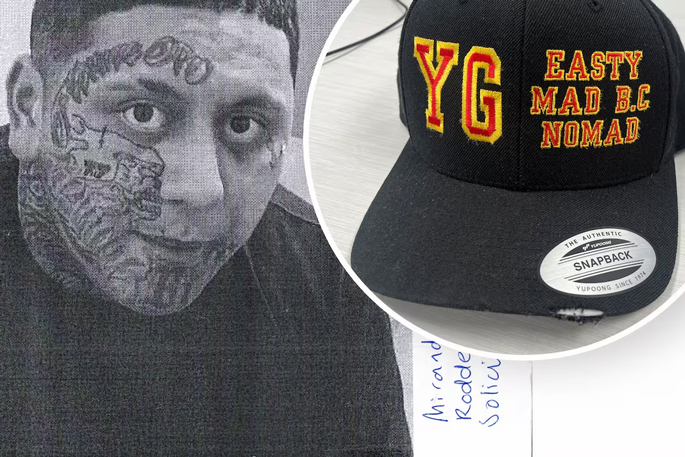

A Nomads member convicted of wearing his gang insignia while at a community event has upped the ante in his challenge of the patch-ban legislation.
In his recent fight, Mana-Apiti Brown’s lawyer asked the court to consider how Warriors or All Blacks fans might feel if they were told they couldn’t wear the teams’ supporters’ gear.
Brown, 19, has already unsuccessfully appealed his conviction stemming from last year’s event, at which he was caught on camera wearing a gang cap backwards.
Now, through his lawyer, Chris Nicholls, Brown has continued his challenge of the new law by asking the High Court to issue a declaration of inconsistency.
Brown has claimed the Gangs Act is inconsistent with the Bill of Rights.
If the High Court makes a declaration, and it isn’t appealed, the Attorney-General must notify Parliament. The minister responsible must then advise the House of the Government’s position on the issue.
But the Attorney-General, represented by Austin Powell and Lauryn Sinclair of Crown Law, has questioned the usefulness of a declaration, stating that when the legislation was passed, politicians were made aware that aspects of the legislation were inconsistent with the Bill of Rights.
Caught on camera
Brown, a patched member of the Bad Company chapter of the Nomads gang, was convicted and discharged in December last year after being seen on CCTV in Naenae wearing a cap with gang insignia on it.
He was in the town centre as part of a community day to celebrate the reopening of the pool, which had been closed for several years while it was earthquake-strengthened.
The Hutt City Council downloaded the footage and reported it to the police, who arrested Brown three days later.
Brown told police the cap, which has the words, “YG Easty Mad B.C Nomad” in red writing with a yellow border, was his uncle’s name in the gang’s writing and colour.
In March, he unsuccessfully appealed his conviction to the High Court after arguing that a conviction for wearing a cap was entirely disproportionate and breached his individual rights.
Now, he’s arguing for his rights of freedom of expression to be recognised so that Parliament might reconsider whether the ban on the display of gang insignia should continue.
At today’s hearing in the High Court at Wellington, Nicholls submitted to Justice Cheryl Gwyn that, while his client’s conviction was lawful and proper under the Gangs Act, it was still unlawful because it cut across the fundamental right to freedom of expression under the Bill of Rights Act 1990 and the International Covenant on Civil and Political Rights (ICCPR), which New Zealand ratified in 1978.
Nicholls told the court that Brown’s actions that day were on the margins of criminal offending, yet he would be tarred with a conviction for the rest of his life.
“My client’s rights have been impinged upon for wearing a cap,” he said, adding that very few would associate the writing with the Nomads gang.
“What 19-year-old doesn’t wear a cap down to the shops? It’s perfectly normal teenage behaviour. Whether they are wearing a rugby league cap, a Bunnings cap, or a Nomads cap, it reflects the age and stage that they are at.”
He said that in wearing the cap, his client was expressing a fundamental human right to express who he was by what he wore.
And he submitted this wasn’t an isolated case, telling the court that around the country, the police were “going hard”.
He cited the case of another client, a Mongrel Mob member, who was sitting in the Pak’nSave carpark in Petone, north of Wellington. While moving from the front seat to the back seat of the car, he was caught on CCTV wearing his gang T-shirt.
Police sought a search warrant and not only seized the man’s T-shirt, but also went into his house and searched his washing pile and drawers looking for the shorts and socks he was wearing that day.
Nichollas submitted that there was an obvious disconnect between this activity and the purposes of the Gangs Act, which sought to reduce the ability of gangs to operate and to cause “fear, retaliation, and disruption to the public”.
He said the law cut into an individual’s right of freedom and expression, and, when it was passed, Parliament hadn’t fully considered the implications the law would have.
“In a nutshell, it goes too far.”
He asked the judge to consider how Warriors fans would feel if the Government said they couldn’t wear their Warriors jerseys around town any more, or a law was passed stopping the All Blacks from wearing their black jerseys because the opposition found them too intimidating.
“The gangs are being made out to be different, but when the principle is applied to other groups in the community, the impact of those rights becomes apparent.
“It’s the right to be free, to be human, and to express our rights in the world.
“This law is affecting a large number of New Zealanders probably every day in New Zealand, and hence there is utility in bringing this to Parliament’s attention in addition to the personal remedy my client is seeking.”
The rule of law applies to all
In response, Powell submitted that there would be a lack of utility in making a declaration and that to do so would be inconsistent with the principle of comity.
Powell also submitted that the court would have difficulty in making a declaration of inconsistency in this case, because it would create the impression that a conviction for a law that arguably breached the Bill of Rights was different from a law that didn’t breach it.
“The rule of law applies to all,” he said.
He also submitted that it wasn’t enough to say the law had been passed and was creating problems, so Parliament should look at it again.
That was the function of the Ministry of Justice, not the courts, he said.
Powell urged the court to show restraint and to use its discretion to withhold a declaration of inconsistency in this case.
“The court is saying you passed a law that is inconsistent with the Bill of Rights Act, and what is the utility in doing that when the law was passed knowing that?” he said.
Sinclair also submitted that domestic courts can’t make declarations of inconsistency with the ICCPR.
At the conclusion of the hearing, Justice Gwyn thanked counsel for their submissions, adding that it was an interesting and difficult issue, before indicating she would reserve her decision.
Catherine Hutton is an Open Justice reporter, based in Wellington. She has worked as a journalist for 20 years, including at the Waikato Times and RNZ. Most recently, she was working as a media adviser at the Ministry of Justice.


9 comments
Pants Leg Up, Pants Leg Down
Posted on 01-10-2025 21:42 | By Yadick
Gangs will do anything for recognition. At the end of the day, it is criminal behavior and activity. Human rights do not evolve to association of criminal behavior, activity or connection. Colours, particular pants leg up or down, numbers, illegal bikes . . . it's all leading directly to criminal intent NOT human rights. Man up boys.
CRUSH the gangs and all affiliation. Don't stand in the way of our Police doing their job. Who's paying for this mongrels appeal? Even in the unlikely event that he's paying out of his own pocket, I ask - who's paying for this mongrels appeal?
Idiot
Posted on 02-10-2025 00:35 | By Opinion100
Common now we got genz gang members, and there opinions are being heard and published give me a break.
You made your bed now lay in it, and all that may come with it will come to you.
Imagine being a gang member and arguing about something as petty as this.
Don't you guys have bigger things to worry about? Like say imports.
Idiot.
Gang patch
Posted on 02-10-2025 08:33 | By peter pan
Who is paying for this court case ?????.Its a gang patch end of story and if ruled any different get Donald to fix it
Warriors & All Blacks
Posted on 03-10-2025 15:17 | By earlybird
are not all about intimidation & law breaking, unlike gangs. I'm surprised a lawyer would be stupid enough to use that arguement.
Really
Posted on 04-10-2025 10:11 | By Biigm63
What is the difference between these guys and destiny church riding around on their bikes with their patches on in groups scaring sectors of our community. On bikes paid for with non taxed money. Pull them over.
Sometimes...
Posted on 06-10-2025 13:20 | By morepork
... the Law is an Ass.
This was a stupid, short-sighted law that was passed to show "something" was being done against gangs. As such, it received public approval. But that still doesn't make it any less stupid.
In a democratic society, people have the inalienable right to form groups whether they are considered anti-social or not.
You can wear whatever you like (as long as it isn't considered legally obscene) and you SHOULD be able to.
Gangs should be monitored and harrassed on the basis of their BEHAVIOUR, and not on what they WEAR. If they obey the Law, there can be no problem; if they don't, then lock 'em up.
We are ALL equal under the Law. (Or SHOULD be; when you pass laws like this, it is clearly targeting a group and can no longer claim equality.)
This stupid Law should be revoked ASAP.
@ morepork
Posted on 06-10-2025 16:09 | By Yadick
I hear what you're saying however, they only get the patches for extreme criminal behavior and it is worn not just as an affiliation but for intimidation. I believe that every thing possible should be done to disrupt and crush gang behavior and if that means they lose their insignia then so be it.
The illegally noisey bikes should be next.
Sorry my friend, I disagree with you on this one.
@Yadick (part 1)
Posted on 07-10-2025 12:26 | By morepork
I respect your disagreement and only ask that you think about the principles underlying this.
If you support Democracy, you can't just support it for people you approve of.
[I welcome discussing issues and have never forgotten a very powerful CEO in Europe, after I apologized for having to present information which I knew he disagreed with, saying to me: "Peter, if I only wanted agreement, I'd argue with a mirror..."]
You say they only get patched for illegal activity, but that doesn't mean patches should be suppressed; rather, the illegal activity should be addressed. (Suppressing the patches is like closing the door AFTER the horse has bolted...)
We don't suppress the wearing of Church, or Freemasonry regalia, or any kind of ethnic clothing, and many people enjoy cosplay in public. The same freedom that enables that, enables the wearing of gang patches.
@Yadick (Part 2)
Posted on 07-10-2025 12:58 | By morepork
There are things we can do to irritate and dissuade gangs from acting illegally. But passing stupid Laws that create exception to existing, useful, legislation, is not the way to do it. The reasons we even have gangs are manifold and complex, but the people in the gangs are NZers and, as such, if we are serious about building an EQUAL society, they have the same rights as everyone else.
I lived for some years in Germany. It is illegal to display a swastika symbol publicly. This is understandable because many people living there went through the Nazi regime and reminders of it are painful. They wrote prohibition against such groups into their constitution. This maintains equality, but makes it clear that such groups are not welcome. Russia's current attempts to foment this (ironic), are not really successful, because of sensible legislation, and public opinion.
Leave a Comment
You must be logged in to make a comment.