


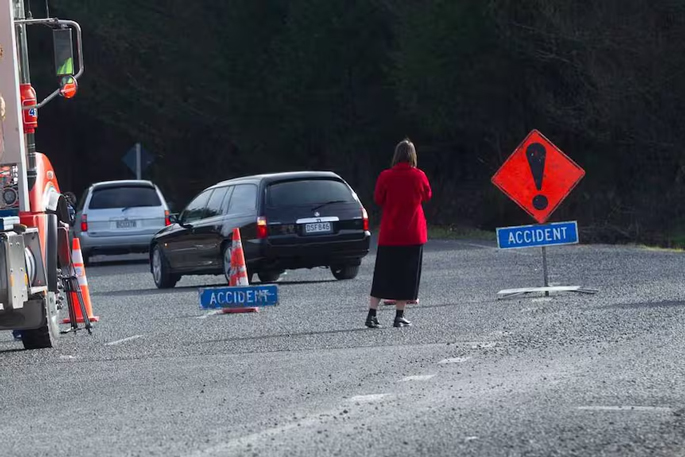

A driver whose van crashed into a forestry truck has had his name cleared after police wrongly suggested he had consumed cannabis and was responsible for the accident that claimed four lives.
A Serious Crash Unit (SCU) report said Storm Lacy should have seen and avoided the truck and trailer unit he crashed into but didn’t because he had cannabis in his system.
This was despite the 22-year-old forestry worker’s whānau, partners and colleagues saying he was not a drug user.
Now, a coroner has cleared Lacy’s name saying he was not responsible for the crash that killed him and three of his workmates who were in the back of the van as they headed into the forest that day.
Lacy, Steven Fasirua Pari, Te Tahi Tango Brass and Johnston Stoogie Ahuriri were all killed in the crash on Bonisch Rd, a sealed arterial route through the central North Island’s Kaingaroa Forest, in the early hours of July 29, 2019.
A fifth worker in the van suffered serious injuries but survived. The truck driver was uninjured.
In findings released today, Coroner Michael Robb said there was no evidence Lacy had consumed cannabis, nor was he responsible for the fatal collision.
He had instead been blinded by the oncoming truck’s headlights and seconds later ran into its trailer, which was blocking his lane and invisible in the dark.
The coroner said the SCU finding that Lacy did not see or react to the trailer because of cannabis use was incorrect.
“The circumstances of the collision point to the driver being entirely sober.”
The SCU inquiry also “ignored” the fact the trailer could not be seen because it had no lights or reflective strips.
Deaths referred back to WorkSafe NZ
Coroner Robb has referred all four deaths back to WorkSafe for further investigation.
In his findings he described an arrangement between WorkSafe and police about who looks into forestry road deaths as “most troubling”, after learning the workplace safety agency did not investigate the accident.
“I refer these four deaths back to WorkSafe New Zealand to undertake an investigation pursuant to their obligations under the Health and Safety at Work Act,” the coroner said.
The coroner said the 35m logging truck with two trailers had turned on to the main route from a side road and its rear trailer was still blocking the northbound lane when the van approached.
Lacy could not see anything beyond the truck’s strong and “blinding” headlights and the trailers did not have lighting or reflective strips along their sides.
When he passed the truck’s cab, Lacy was driving within the speed limit at 80-90km/h.
At that speed, he would have covered the 32m to the point where the trailer was still blocking his lane in less than one second.
“There was insufficient time for the driver of the van to avoid a collision with the logging trailer blocking his lane,” Coroner Robb said.
“The trailers were unlit and, as a consequence, the [rear] trailer was invisible to the van, as it would have been invisible to any other northbound traffic.
“It was the failure to have lighting on the sides of the trailers, or any other reflective material, that ultimately caused the collision.”
The coroner found all four men died from head injuries sustained in the collision.
Blood samples taken
The police SCU report writer said Lacy should have seen and avoided the trailer but did not see it because he had consumed cannabis.
This was based on lab test results of blood samples that had been taken from all of the deceased.
However, those who knew Lacy, a volunteer firefighter, said he was not a cannabis user.
 One of the entry points into Kaingaroa Forest near where the fatal crash occurred. Photo / Stephen Parker
“Those that personally knew the driver of the van over many years, were adamant that he drank little, kept fit and did not smoke cigarettes nor cannabis. This was emphatically confirmed by his partner,” Coroner Robb said.
“Storm’s partner, employer and whānau were united in their position that Storm did not consume cannabis.”
The survivor from the van also told the Coroner’s Court that Lacy did not use cannabis, but that other people he worked with did.
The coroner’s report said there were discrepancies in the forms accompanying the blood samples and “no evidence” of how they had been handled.
The processing of the samples had not been subject to police oversight.
Possible ‘labelling error’ at lab
“The prospect of a labelling error in respect of the samples attributed to the van driver were immediately and consistently raised by those that knew the van driver,” the coroner said.
The report said Lacy had been driving appropriately and not too fast, was aware of his surroundings and was focused.
There was evidence he had tried to turn the van towards the left in the “split second” before the collision.
“I find that the driving of the van driver played no role in the collision,” Coroner Robb said.
“I find that the SCU report incorporated a flawed statement in attributing any aspect of the collision to the driver of the van or to cannabis consumption.”
 Bay of Plenty roading police manager Inspector Brent Crowe at the scene of the fatal crash. Photo / Stephen Parker
Police make changes
Acting Assistant Commissioner Penelope Gifford said the police would take some time to thoroughly consider the coroner’s findings and consider any impact on current processes.
Some changes had already been made within the SCU.
“Bay of Plenty Police have already implemented changes in Serious Crash Unit investigations, including having a senior investigator overseeing all investigations, including all fatal crashes,” she said.
“Our thoughts remain with the whānau and loved ones of the four young men who lost their lives in this devastating incident.”
A WorkSafe NZ spokesperson said the agency would now review its memorandum of understanding with police about who takes the lead on vehicle crashes, “to ensure it is fit for purpose and operating effectively”.
“Having received the coroner’s findings, we are now actively considering next steps,” the spokesperson said.
“The coroner’s referral gives WorkSafe a further six months to file a charge if appropriate.”
Ric Stevens spent many years working for the former New Zealand Press Association news agency, including as a political reporter at Parliament, before holding senior positions at various daily newspapers. He joined NZME’s Open Justice team in 2022 and is based in Hawke’s Bay.


0 comments
Leave a Comment
You must be logged in to make a comment.