


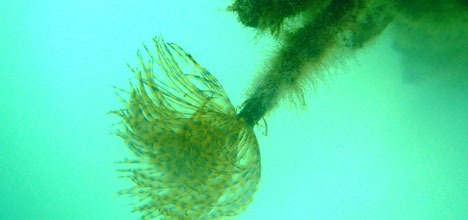
More of an invasive Mediterranean aquatic pest has been found in the waters of Pilot Bay – almost a month after the first discovery.
Bay of Plenty Regional Council is today advising a second Mediterranean fanworm has been located by divers on the hull of a boat this week.
Mediterranean fanworm found on the hull of a boat moored at Pilot Bay. Photo: Phil Ross.
.jpg) Clubbed tunicate sea squirts.
Clubbed tunicate sea squirts.
Several unwanted marine clubbed tunicate sea squirts have also been found in the harbour.
Both the Mediterranean fanworm and clubbed tunicate are aquatic pests that have become established in other parts of New Zealand, including in Auckland's Waitemata Harbour and in Lyttelton Harbour.
Council's natural resource operations general manager, Warwick Murray, says council has contacted the boat's owner since the discovery.
'He's very concerned that his boat was hosting these marine pests and has made arrangements to have it hauled out and de-fouled immediately,” says Warwick.
The divers have been searching for Mediterranean fanworms in the southern end of Tauranga Harbour since the discovery of a single specimen in Pilot Bay in late September. The search is now approximately 85 per cent complete.
Warwick says council and Ministry for Primary Industries staff are pleased only two of the invasive fanworms have been found so far, and that the clubbed tunicate has only been found in one location to date.
'The fanworms that have been found are immature and have not yet had the opportunity to breed.
'We're hopeful that we've caught these incursions before they've become more widely spread. If they became established in Tauranga Harbour, both of these marine pests could have a negative impact on our kaimoana; including mussels, oysters and scallops.
'They can interfere with boating, aquaculture and recreational pursuits.”
He is encouraging boat owners to be vigilant and ensure they are not bringing pests into the region.
'They can do this by keeping their anti-fouling paint in good order, and cleaning their hull regularly, in a place where the de-fouling can be safely captured and contained such as at a haul out facility. That's especially important before they travel to a new area.”
MPI and the regional council also encourage boaties to report any unusual sea life by calling the MPI Exotic Pest and Disease hotline, phone 0800 80 99 66.
'We need to know the location. A specimen or photo is helpful too,” says MPI senior advisor Kathy Walls.
The dive survey is expected to be completed this month, subject to favourable weather and water clarity.
Once the extent of the incursions has been defined, the council will work with MPI to determine the best approach for preventing further spread.
Marine pest identification guides are available online at http://www.biosecurity.govt.nz/files/pests/salt-freshwater/2012-New-Zealands-Marine-Pest-Identification-Guide.pdf

2 comments
Aquatic Pests
Posted on 29-10-2013 16:01 | By peecee09
It is all very well for Mr murray to urge 'boaties' to be extra vigilant but has he the power to take on the most likely culprit The Port of Tauranga who should be forced to check the hulls of ships on a regular basis to ensure they are not infested as they are the most likely culprits for bringing these and other aquatic pests from overseas. The port as part of its responsibility to keep our harbour 'CLEAN' should constantly monitor foreign vessels at their expense in order that our harbour remains pristine and free of pollution and foreign pests.
Overit
Posted on 30-10-2013 12:32 | By overit
So true peecee09. So much for globilisation-have our pests too!
Leave a Comment
You must be logged in to make a comment.