


The German owners of a container ship that leaked 1000 litres of heavy fuel oil into the Tauranga Harbour in July last year has been fined $30,000.
Owner of the Liloa - MS Jule Schiffahrtsgesellschaft GmbH & Co. KG - pleaded guilty to a charge of discharging a harmful substance into water in the coastal marine area in the Environment Court at Tauranga yesterday.
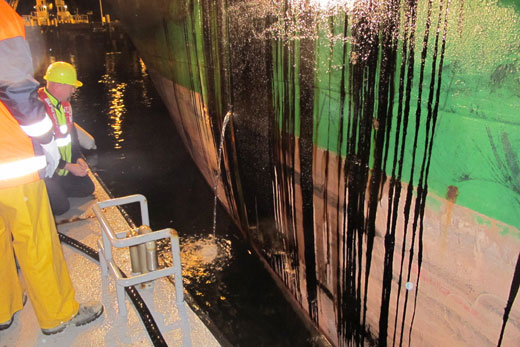
About 1000 litres of heavy fuel oil spilled into Tauranga Harbour during a re-fuelling mishap on the cargo ship Liloa. Photo: Supplied.
The company was convicted and fined $30,000 on the charge, which carries a maximum penalty of $600,000. This was an addition to the $17,107 the company paid in clean-up costs.
The Liloa – a cargo ship transporting loads around the South Pacific – has been refuelling at the Port of Tauranga every three to four weeks since March 2013.
On July 3 last year Liloa was docked at the Port on its seventh re-fuelling stop on return from Tonga to transfer 163,000 litres of heavy fuel oil into the vessel. Read about the spill here.
During the re-fuelling process one of the tanks did not have enough capacity and at 4.20pm the crew saw the tank was overflowing with oil spilling from the deck into the sea. They requested an emergency stop to the bunkering.
The deck was ankle-deep with oil, overflowing from the deck to the sea in two places on the vessel's far side from the wharf. It also spread to the port side of the deck, but was not overflowing on that side, due to the vessel's starboard list.
The chief engineer says the vessel's bunkering documentation was wrong as he had been too busy. The vessel's fuel tanks should have flowed to an overflow tank, but this had not happened, and the vessel's fuel tanks had no pipes connecting them to the overflow tank.
When the second engineer realised the No.2 starboard tank was overflowing, he began transferring HFO from the No.2 starboard tank into other tanks, says the chief engineer.
Bay of Plenty Regional Council's Harbourmaster was notified and saw an oil slick 100 metres wide and 600 metres long stretching towards Mount Maunganui and extending between the boats on swing moorings at Pilot Bay. Regional Council officers found the vessel's crew cleaning up the oil on the deck using saw dust, sorbent pads and rags.
The Regional Council says it arranged for the removal and disposal of several 200 litre drums of oily waste, rags and clean-up materials from the vessel and for a sucker truck to remove the liquid waste that had been collected and the operation was completed in the early hours of the following morning.
A light oil residue was found on the beach and sea grass at the high water mark along the beach at Pilot Bay the following day, which was cleaned up by council staff.
A local sea kayaker also reported that his sea kayak was coated with oil from the spill.
Maritime New Zealand issued a notice to the vessel's master identifying deficiencies in the vessel's fuel bunkering procedures.
The company conducted its own internal investigation into the cause of the spill and tightened its bunkering procedures. It said the oil overflowed because of confusion between the chief engineer and second engineer about which tanks were to be filled, and because the second engineer relied on an alarm that was not turned on at the time of the fuel transfer.
Regional Council Pollution Prevention Manager Nick Zaman says council's investigations revealed a number of errors in the vessel's bunkering procedures and poor record keeping.
'This is a timely reminder that this type of practice is not going to be tolerated, and the onus is on all vessel owners to make sure their bunkering procedures are up to date and that their crew follow these procedures,” says Nick.
'With the expected increase of vessels using the Port we will be taking a hard line against these types of incidents.”

0 comments
Leave a Comment
You must be logged in to make a comment.