


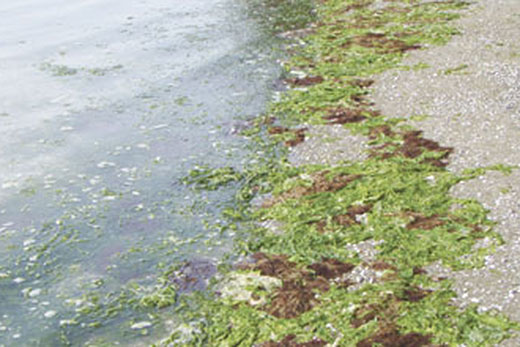
Bay of Plenty Regional Council and Tauranga City Council staff are preparing for plenty of sea lettuce in Tauranga Harbour this year, despite a slow start to the season.
The regional council reports no big blooms of sea lettuce have affected the harbour so far, after staff completed their first round of summer checks for sea lettuce at key Tauranga Harbour beaches this week.
No big blooms of sea lettuce have been reported so far this season.
'Sea lettuce is a naturally occurring algae that's native to New Zealand. Its growth is mainly influenced by coastal currents, water temperature and nutrient levels,” says Regional Council senior environmental scientist Stephen Park.
'Over the last 25 years we've seen a trend of particularly large ‘blooms' or high growth periods during El Nino years.”
This week council staff found very low levels of washed up sea lettuce along the city beaches such as at Matua, Otumoetai and Memorial Park, but some accumulations along the western coast of Matakana Island and the northern end of the harbour, says Stephen.
'Sea lettuce washes up wherever the wind and currents carry it. The strong westerlies we've been having recently have kept city beaches clear and sent small amounts toward Matakana.”
Sea lettuce is known to cause a strong sulphur odour when it's deposited in large quantities, and then decays on beach and foreshore areas.
'People should avoid large areas of decaying sea lettuce. The poisonous hydrogen sulphide gas it may release can be dangerous, especially if conditions are calm.
'Sea lettuce can also drift around the harbour and near shore coastal waters, creating an entanglement nuisance for swimmers, fishers and commercial shipping.
'We'll continue to work with Tauranga City and Western Bay District Councils over summer to remove nuisance accumulations from high use public areas along the Tauranga Harbour foreshore. It's all part of our work to keep Te Awanui Tauranga Harbour healthy and accessible,” says Stephen.
He says everyone can help by taking a bit home and using it in their compost or as garden mulch.
'It needs to be used sparingly though, and mixed with other materials to avoid salt build up in the soil and loss of sensitive plants.”
Stephen has been supervising a number of sea lettuce research projects since 1991, to discover more about its growth and interactions in the Tauranga Harbour.
Two PhD study reports are expected to be completed later this year and a new three-year study on nutrient dynamics will start in 2015.
'There's been suggestions in the past that sea lettuce growth is caused mainly by sewage and industrial pollution into the harbour, but we know that's not the case. All the larger discharge points around the harbour have been removed or had treatment systems in place since the mid-1990s.
'The research so far is showing that the worst blooms of sea lettuce occur during periods of dryer weather and persistent offshore winds associated with El Nino. Sea lettuce is responsive to any nutrient source, but the particularly large blooms happen when there's less land run-off and a higher proportion of natural, ocean derived nutrients in the harbour system. As we learn more about sea lettuce dynamics in the harbour, we may be able to find new ways to reduce the public nuisance it generates.”

1 comment
ancient problem
Posted on 26-09-2014 15:28 | By peecee09
I can remember playing in tidal pools full of sea lettuce over 60 years ago and my Dad cursing it when fishing at Hunters Creek.So accept it is just an annoying quirk of nature and live with it.
Leave a Comment
You must be logged in to make a comment.