


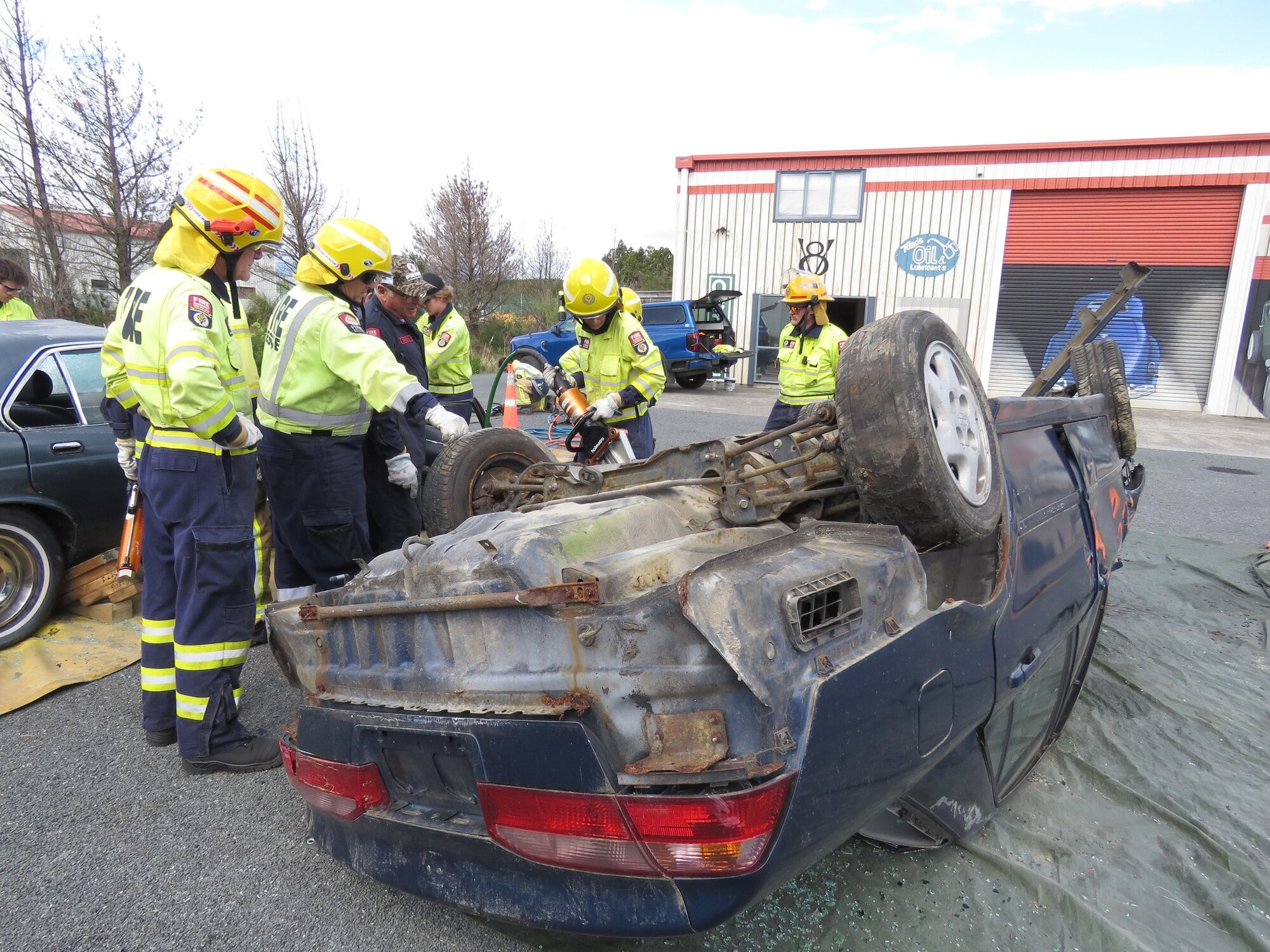
When Danielle Lister and Siobhan Arrow turned up to Henry’s Rod Shop on Marshall Rd on the morning of October 18, they had no idea what they would stumble into.
It was just like a real-life callout to a Motor Vehicle Accident (MVA) with their Katikati Volunteer Fire Brigade.
One after the other, vehicles of all models, shapes and sizes were placed on all sorts of angles, with different areas of damage as if they’d just been in an accident or collision.
Katikati Volunteer Fire Brigade acting chief fire officer Craig Gray had organised the two-day Motor Vehicle Extrication (MVE) course at his own workplace, led by two Fire and Emergency New Zealand National Training Centre tutors.
“I organised it here so local brigades could attend, training was out of the public eye, and the yard I work at has heaps of space.”
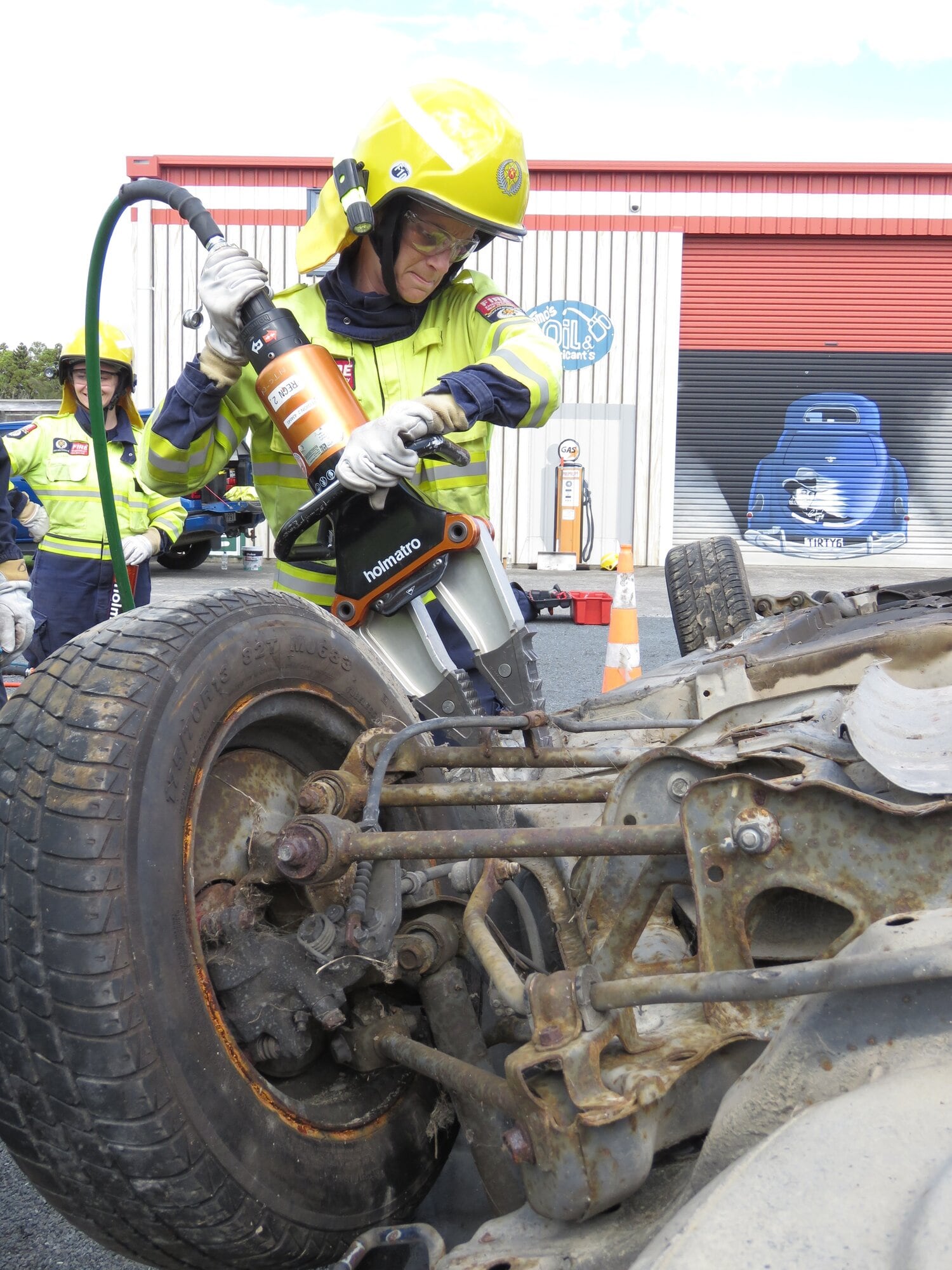
Katikati volunteer firefighter Danielle Lister using the jaws of life in a Motor Vehicle Extrication (MVE) course this month, as fellow trainees watch on. Photo / Merle Cave
Gray said 12 firefighters completed the course – six from his Katikati brigade, four from Thames and two from Waihī – on October 18-19 outside their work hours.
In fact, a range of local brigade personnel were present to help with the event – right down to cooking meals for the trainees.
Vital
For firefighters to attend MVAs and get hands-on with the tools on a rescue tender appliance, they need to first complete this MVE qualification.
With State Highway 2 on the Katikati brigade’s doorstep, Gray said it is hugely important for firefighters to undertake this vital training. If a vehicle accident occurs in a 100km/h zone in the district, usually two rescue tenders are sent to the scene. This means there’s a high likelihood Katikati firefighters will be called upon, said Gray.
“Being a rescue tender, we cover from Waihī through to Tauranga. We have back-up from Waihī and Tauranga. But to actually use the equipment on the rescue tender – such as the jaws of life – firefighters have to hold this qualification.”
Gray’s brigade found damaged vehicles and had some donated by the public and MetalCo to use for the training weekend.
“We go through 10-12 cars across two days.”
Afterwards they’re collected for scrapping.
Different scenarios
For the training, damaged vehicles are placed in different positions – including upside down, resting on their roofs – so firefighters can learn how to approach different scenarios that could occur in real life.
“They learn everything from removing roofs and doors to smashing windows safely, doing a dash roll – all techniques to extricate someone from a vehicle safely after an accident. What technique they use will depend on the mechanism of the accident, as to what they would do first,” said Gray.
Katikati volunteer firefighter Siobhan Arrow said she gained “lots of learning” this month from her first MVE course.
“It qualifies you to use the cutting gear – so the tools like your spreaders, cutters, rams etc that you may need if there is an MVA.
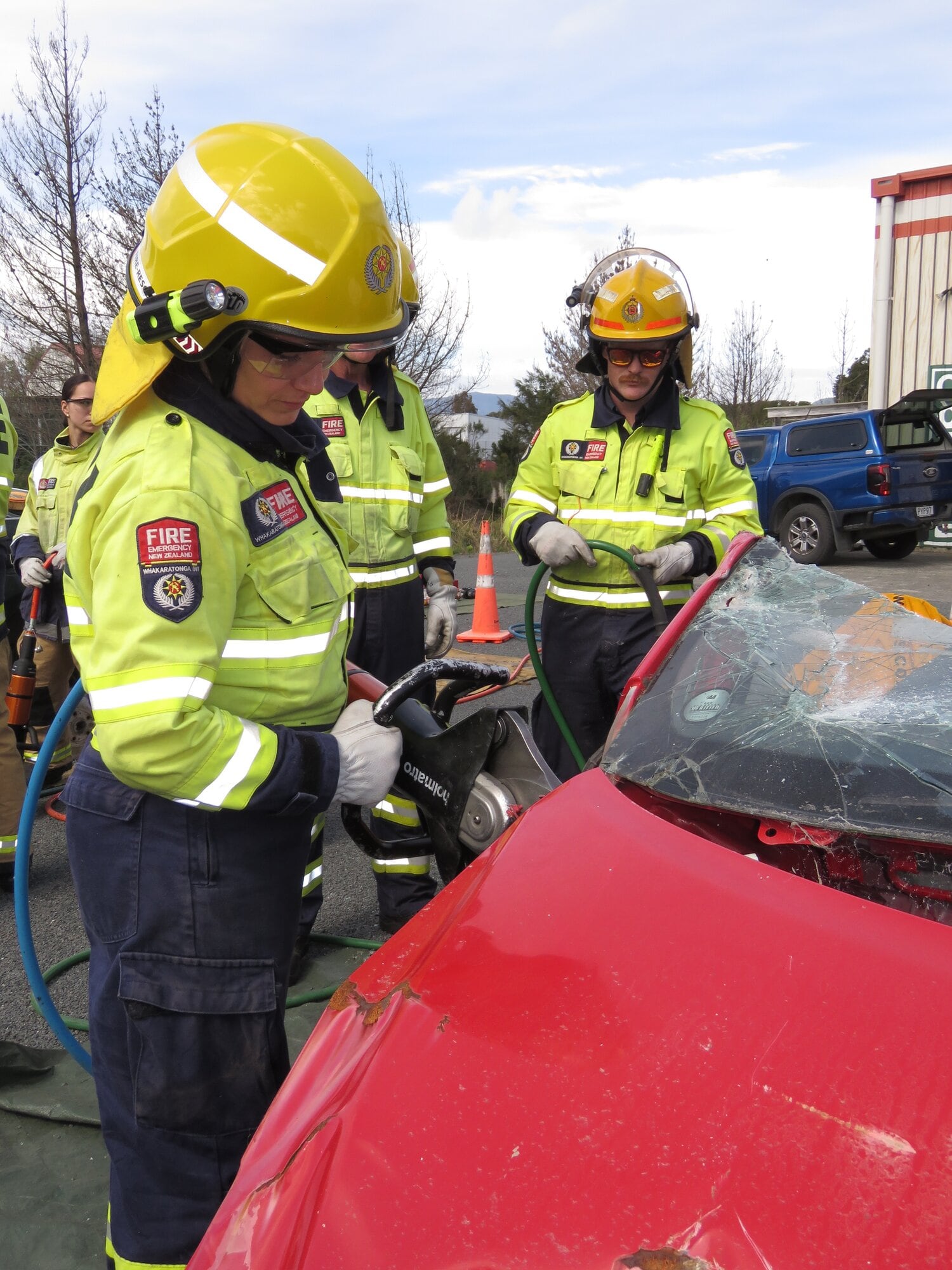
Katikati volunteer firefighter Siobhan Arrow using the using the jaws of life in the Motor Vehicle Extrication (MVE) course. Photo / Merle Cave
“It was [about] learning how different types of cars work, what’s in them and how we can extricate people safely from them,” said the 32-year-old, who joined the brigade 18 months ago.
“It was good to get on the tools and know that if we find ourselves in that type of situation that we can do all the right things to get people out of vehicles safely.”
Fellow volunteer firefighter Danielle Lister, who also joined the brigade 18 months back, found the MVE course “very interesting” and a “big challenge”.
“The training pushed me beyond my physical limits – because I am a small lady – which was good.”
Most unaware
Lister said people were largely unaware of the training volunteer firefighters undertake to ensure they are skilled and well-equipped to attend callouts – which can range from fires to medical assistance jobs, weather events and vehicle accidents.
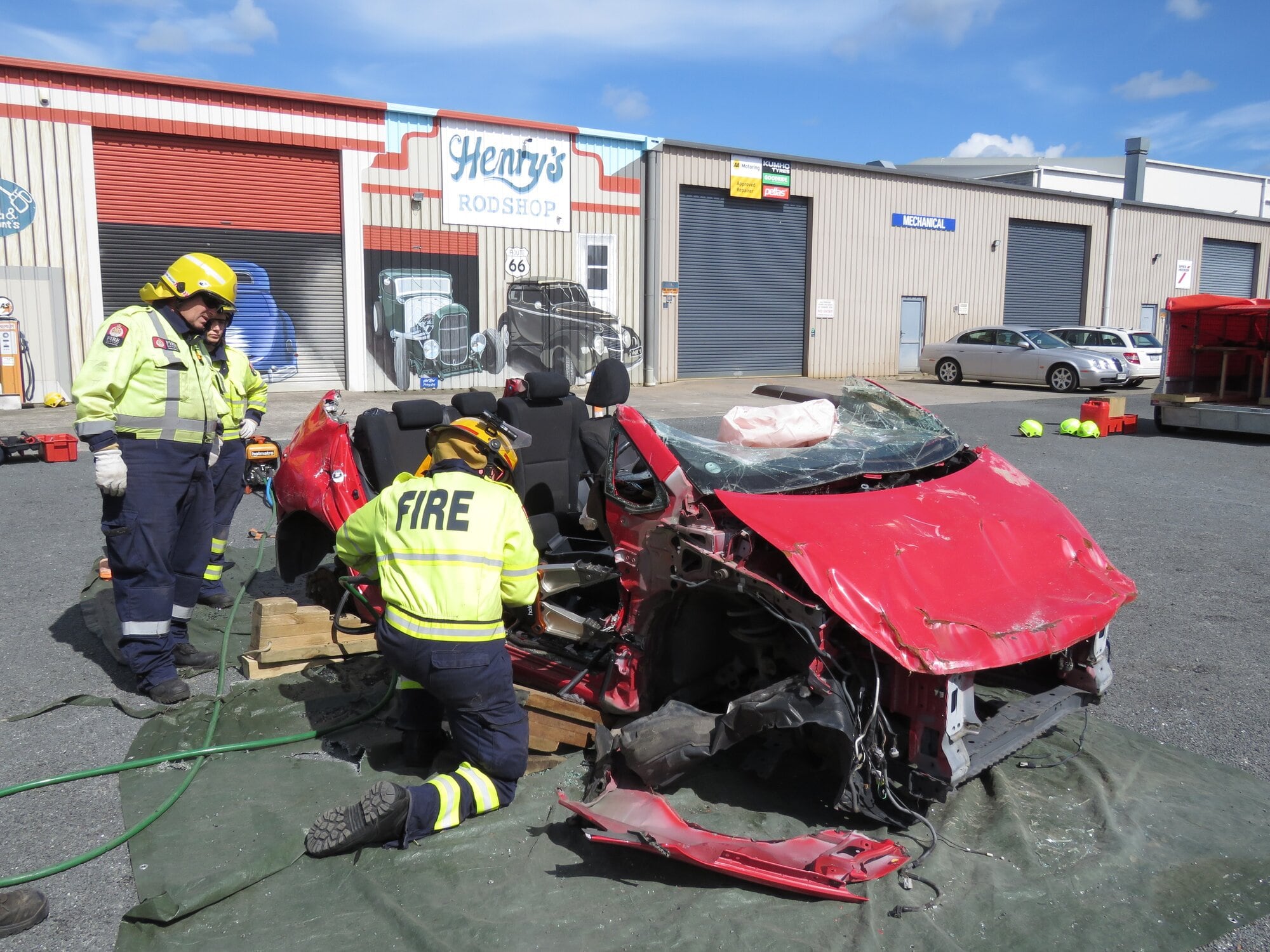
Three firefighters learning how to use rescue tender equipment on the recent MVE course in Katikati. Photo / Merle Cave 006: need name ….. Photo / Merle Cave
Arrow agreed. She said while the public often hear the fire siren wail through Katikati, many wouldn’t know of the many courses volunteers need to tick off involved just to be able to step into a fire appliance.
“The siren goes off 7pm every Tuesday – that’s our normal weekly brigade training. But when you first join, you do a seven-day recruitment programme in Rotorua – this is an intensive course to learn all the basics.
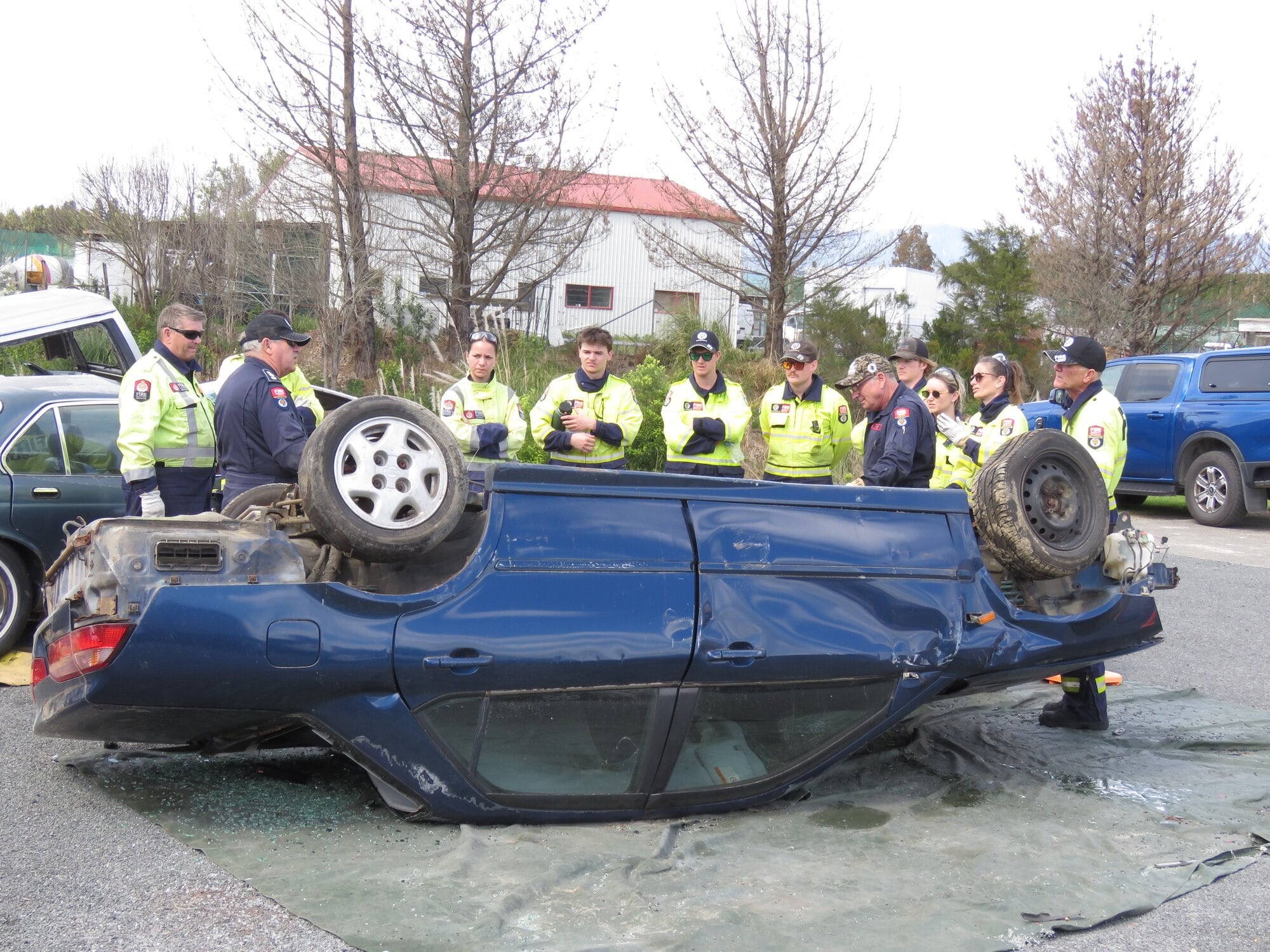
Two Fire Emergency New Zealand’s National Training Centre tutors discuss with MVE course firefighters an extrication plan before helmets go on to undertake the work. Photo / Merle Cave
“Then you undertake a medical co-response two-day training course so you’re CPR-qualified. If you want to keep moving up the ranks, the next is a five-day course to become a qualified firefighter,” said Arrow.
‘Loving it’
There are also courses, such as the MVE training, that need to be completed by all firefighters regularly to refresh and upskill the brigade.
“So everyone is forever learning – especially with new technology that comes in, new regulations and new equipment. It’s constant,” said Arrow. And much of it is in the volunteers’ weekends or other periods of leisure time. Just like Lister, though, Arrow joined the brigade to help the community and was “loving it!”

0 comments
Leave a Comment
You must be logged in to make a comment.