


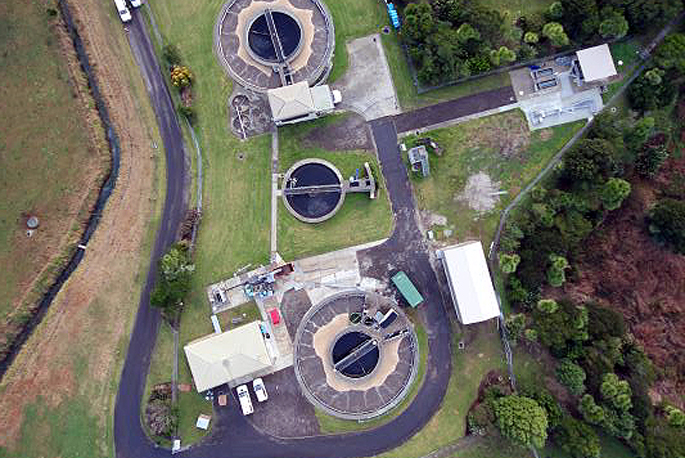
A $96 million wastewater treatment plant will be built in Te Puke - the Western Bay of Plenty District Council’s largest-ever capital project.
The new facility will replace the 1987-built Gordon St facility, which the council says is no longer big enough for Te Puke’s growing population or able to meet discharge and seismic standards.
The new plant will provide capacity for an extra 3000 people.
“It’s designed to meet much higher environmental standards, provide greater resilience, and support the long-term health of both our community and our environment,” a Western Bay of Plenty District Council statement said.
Interim council chief executive Miriam Taris said this was the largest capital project ever undertaken by the council and would ensure the right infrastructure was in place to support Te Puke’s long-term future.
She said it would protect waterways and ensure reliable wastewater services as Te Puke continued to grow.
Infrastructure group general manager, Brad Singh, said the new plant will use modern Invent SBR treatment technology – a proven process internationally.
“This equipment is already being used in New Zealand, but the new Te Puke plant will combine it in a way that is a first for the country,” Singh said.
“It’s attracting a lot of interest from the local water sector and we’re proud to be leading the way.”
The system worked by treating wastewater in a single tank in cycles – filling, cleaning, settling and draining – so it cleaned the water in one place, with improved aeration, meaning the bugs used to help break down the wastewater could do so more efficiently.
Construction was expected to start in late December or early January, with the plant operational in early 2028.
The council has awarded the contract to design and build the new plant to McConnell Dowell Constructors Ltd.
The contract decision was made at the council’s September 4 meeting but negotiations and planning work to confirm this had just been completed, the statement said.
The project would be delivered in stages, with the first stage providing capacity for a population of about 13,000 people, plus Stage 1 of the Rangiuru Business Park.
The plant would include the key infrastructure required to enable a second stage that would progress as growth requires, futureproofing the facility until at least 2054.
The council considered a range of options, including upgrading the existing plant, but concluded that a replacement plant offered greater resilience, lower long-term costs and stronger compliance with environmental standards.
Cost increase
The budget for the project has significantly increased in recent years.
A report presented to the council in-confidence in September has been made public, albeit with much of the cost breakdowns redacted.
It said prior budget estimates for the project did not represent the full scope of work.
The nominal $61.9m estimate in 2022 was for physical works only, as was the $78m budgeted in the Long-Term Plan 2024/34.
The latest figure included costs such as iwi engagement, demolition, wetland conversion, legal, probity, insurance, as well as escalations and contingency.
“The current $95.7m figure therefore represents a complete and more robust project budget or the project lifecycle, as confirmed by independent advice.”
The project cost would be shared between ratepayers, developers, and the Rangiuru Business Park, with debt funding recovered through rates and contributions.
Construction Timeline
Earthworks begin December 2025 → January 2026
Main construction phase beings June → July 2026
Plant operational January 2 → March 31, 2028
-Source: Western Bay of Plenty District Council
Stay up to date with the latest project news and updates on the Your Place Tō Wāhi page: yourplace.westernbay.govt.nz/tpwwtp.

0 comments
Leave a Comment
You must be logged in to make a comment.